Time to relax on a Sunday with some cheesy but super fun musical short subjects, early 1930's style, from none other than Vitaphone!
Kicking this off: excerpts from Vitaphone's teenage dancin' sensations Hal Le Roy and Mitzi Mayfair in TIP TAP TOE (1932) and USE YOUR IMAGINATION (1933).
Later in the 1930's, the Vitaphones teamed Hal with Toby Wing and June Allyson, but, alas, neither could match Mitzi Mayfair's formidable terpsichorean mojo. Too bad she didn't make more movies in addition to these Vitaphone short subjects and the WW2 musical Four Jills In A Jeep.
Hal's breakthrough was in the Ziegfeld Follies and, all these decades later, his rubber-legged moves and tap dancing remain amazing. He was a heckuva entertainer.
Hoofin' Hal continued working well into the television era and tapped his way through The Ed Sullivan Show. Here he is doing a spirited throwdown with fellow tap guru Clayton "Peg Leg" Bates.
Next up: Phil Spitalny & His Musical Queens (a top-notch group)! There weren't nearly enough symphony orchestra and big band jobs for exceptional female musicians during the Great Depression, so Mr. Spitalny (who I first heard about when perennial nogoodnik Boris Badenov made a reference to him in the Rocky & Bullwinkle Wossamatta U series) happily hired them, a few years before the formation of The International Sweethearts Of Rhythm.
A recording artist who starred in terrific musical short subjects in the pre-code era was Ruth Etting a.k.a. The Sweetheart Of Columbia Records.
The excellent Ruth Etting musical short ARTISTIC TEMPER (1932) is distinguished by an extended sequence that takes place in an automat and sets up her subsequent songs.
That clip got me thinking of Lisa Hurwitz' outstanding 2021 documentary THE AUTOMAT. It's a great slice of 20th century history and, naturally, Mel Brooks' appearance is immensely enjoyable. I want some automat coffee, NOW!
Back to splendid songstress Ruth Etting, this film buff wonders if a collection of her musical short subjects produced by Vitaphone and Paramount Pictures is available on DVD or Blu-ray.
If there is, we'll buy it - she was great!
One of our favorite Vitaphones, PLANE CRAZY (1933), stars the pert comedienne Dorothy Lee, key onscreen cohort of RKO Radio Pictures' sprightly comedy team of Bert Wheeler & Robert Woolsey and especially wonderful in PEACH O' RENO (1932), HIPS HIPS HOORAY (1934) and COCKEYED CAVALIERS (1934). Dorothy's megawatt charm, wiseguy comics unconvincingly portraying aviators and (of course) cheesy production numbers rule the day.
In last weekend's KFJC Psychotronix Film Festival we ran a hilariously cheesy and shameless Soundie from the early 1940's about a gas station staffed by showgirls and mostly patronized by unapologetically pervy guys. The budget in the following Vitaphone musical (in glorious Technicolor) about a showgirl service station, Service With A Smile, is significantly higher so the outfits are a lot better.
Better yet, the 1934 gas station customers, unlike their 1940's counterparts, are not leering lechers!
And, as is the case in the Vitaphone Technicolor short subject Good Morning Eve, the celebrated Ziegfeld Follies comedian Leon Errol, veteran of a gazillion RKO 2-reelers (The Jitters) and a memorable appearance with fellow comic and boozehound W.C. Fields in NEVER GIVE A SUCKER AN EVEN BREAK, is on hand.
In another fun Technicolor musical short from this Vitaphone series, Wini Shaw, the super splendid songstress who sang the Lullaby Of Broadway in GOLD DIGGERS OF 1935, co-starred with goofy dialect comedian El Brendel and scantily clad showgirls dressed, barely and implausibly, as Native Americans. I'm not kidding!
In closing, way back on pre-lockdown February 8, 2019, Way Too Damn Lazy To Write A Blog's post was devoted to, in large part due to the untimely passing of the driving force begin The Vitaphone Project, Ron Hutchinson, the rediscovery of the incredible 1920's time capsules known as Vitaphone Varieties. Posted Vitahone Varieties then, but to finish today's Vitaphone-centric post, we shall give 'em an encore. Here are a slew of Vitaphone Varieties - enjoy! And thanks again to the late Ron Hutchinson!
Since the great George Gershwin was born on this very day, September 26 in 1898, today we shall focus on musicals; after all, Your Correspondent grew up (or chose not to) watching Fred n' Ginger features, the frequently musical Ernie Kovacs Show, Looney Tunes, Robert Youngson slapstick comedy compilations AND Jay Ward Productions' Fractured Flickers on TV.
Here at Way Too Damn Lazy To Write A Blog, we plead "guilty as charged" (no contest) to liking 1930's musical 1-reelers, very likely enough to be a charter member of the "Men Who Love 1930's Musical Shorts Too Much" 12-step group.
Here, in a Vitaphone Melody Master short featuring Vincent Lopez & His Orchestra, is a teenage version of megawatt musical comedy powerhouse Betty Hutton. Our favorite part is when she clucks like a chicken. Take it, Betty!
Just one of several tremendous musical short subjects directed by Joseph Henabery for the Vitaphone Melody Master series is this massive entertaining 1-reeler starring innovative big band swingmeisters Jimmie Lunceford & His Orchestra.
Two of the "string swing kings" were Joe Venuti and Eddie Lang, in a clip from the 1930 Universal feature, The King Of Jazz. It's a safe bet that across the pond, Django Reinhardt and Stephane Grappelli were paying big time attention to the duo's recordings.
Eddie Lang also appeared in The Big Broadcast with Bing Crosby. Tragically, the virtuoso guitarist died in 1933 as the result of a botched operation.
Also performing "Dinah" on the silver screen, as Bing Crosby did in the previous clip, were the gold standard for vocal groups in the 1930's: The Mills Brothers.
The Mills Bros. popularity was such that Decca recorded sides in which the harmonizing brothers collaborated with none other than Louis Armstrong. Fortunately, Paramount Pictures also captured The Mills Brothers' four-part harmony heroics on film in a slew of 1-reel musicals and Fleischer Studio Screen Songs cartoons.
Next on the itinerary is a quick detour from the 1930's back to the Roaring Twenties. The genre of the musical short subject actually began in 1923 with the historic DeForest Phonofilms, and then, starting a couple of years later, the Vitaphone Varieties and Fox Movietone Musicals.
As a result of several 1930's Merrie Melodies cartoons devoted to radio stars (I've Got To Sing A Torch Song, The Coo-coonut Grove, Toy Town Hall, The Woods Are Full Of Cuckoos), dyed-in-the-wool film buffs born long after the popular bandleader's death in 1943 know who Ben Bernie was.
The orchestra leader, among those credited for the song "Sweet Georgia Brown", was enormously popular on radio. Here he is, The Ol' Maestro, in 1925!
In the Vitaphone Varieties, vaudeville met the early days of big band and jazz. These ensembles unquestionably feature a strong fun element and goofiness that goes hand-in-hand with the musicianship. How can one not like a band with the name Dick Rich & His Melodious Monarchs?
Way Too Damn Lazy To Write A Blog is also "guilty as charged" of possessing an abiding love for stage and screen songstress Lillian Roth - and not just because she appeared with favorite comedians The Marx Brothers in Animal Crackers and was the featured live-action performer in several incredible Fleischer Screen Songs cartoons (just "follow the bouncing ball").
Known more for her offscreen difficulties (largely due to the book and movie I'll Cry Tomorrow) than her show business comebacks and stage triumphs, Lillian Roth, was a legendary vocalist. The following photo from The LIFE Picture Collection, one of many historic shots, is a better way to remember Miss Roth, a dynamic, show-stopping performer who could belt 'em out with the best of them.
The following Paramount 1-reeler, Meet The Boyfriend, isn't quite as cool as Lillian singing Little Alimony Sal in the 1934 Vitaphone mini-musical Story Conference, but demonstrates her beauty, chutzpah, winning charm and ability to put a song - ANY song - over nonetheless.
Big thanks to all of the above for their invaluable assistance in keeping this blogger's Sunny Side Up.
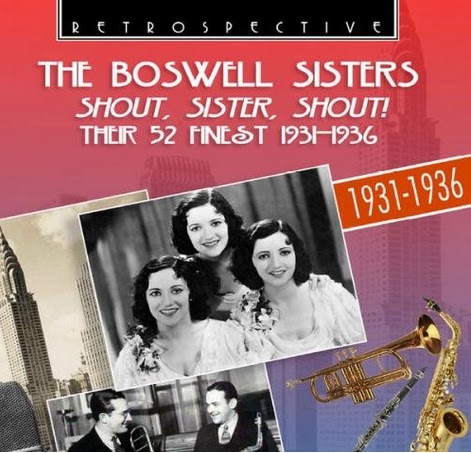
Wrote about The Boswell Sisters, three gals linked in sweet harmony, back in 2011 upon hearing about a documentary covering their illustrious career. To some degree, nobody has quite accomplished what the vocal trio did before or since - although many have tried!
High on the long list of New Orleans' finest musical talent, the fabulous Boswell Sisters, Martha (1905 - 1958), Connee (1907 - 1976) and Vet (1911 - 1988) were a truly groundbreaking act.
With Glenn Miller charts and the skilled backing of New York session musicians Benny Goodman, Bunny Berigan, Tommy & Jimmy Dorsey, Carl Kress, Eddie Lang and Joe Venuti, The Boswell Sisters recorded numerous sprightly tunes for Okeh and Brunswick.
They waxed great song after great song, as did their early 1930's contemporaries - Satchmo, Duke, Fats Waller, Cab Calloway, Earl "Fatha" Hines, Coleman Hawkins, Fletcher Henderson And His Orchestra and Don Redman.
They were certainly among the advance guard in their early career on radio and recordings, possibly were the first vocalists to tackle the songs of Duke Ellington.
Back to the documentary, the Kickstarter fundraiser for Close Harmony was successful and recent rumblings indicate that production is on a roll. It's highly likely to include at least one clip of the Bozzies singing Rock And Roll!
From the Facebook page by the documentary filmmakers, Joshua Tree Productions: "It's been too long since we've updated anyone here, but we've been very busy and are progressing steadily, even rapidly now."
"There's a lot of exciting things happening, some of which we can't yet talk about in a public forum yet. But, today we were making a presentation to a group of fans at the Historic New Orleans Collection as a part of the "Boswell Sisters, Their Music Goes Round and Round" symposium. We will now be spending the next two days recording material HNOC has graciously allowed us to use. It's a huge accomplishment for us, and we are enormously grateful to them."
We wish the filmmakers well and thank them for the following still of Bing and the Bozzies, posted on their website.
Music fans around the world await the completed film. Here's "The Boswell Sisters: Close Harmony" trailer on Vimeo.
Think there's a good bet material on other New Orleans greats - Louis Armstrong, Sidney Bechet, Henry "Red" Allen, Irma Thomas, Fats Domino, Guitar Slim, Dr. John, James Booker, Professor Longhair, Harry Connick Jr., all variations on The Meters, Radiators and The Wild Tchoupitoulas, Allen Toussaint, Ed Blackwell, The Marsalis Family, The Batistes, The Nevilles, Donald Harrison, Terence Blanchard and Nicolas Payton, to name a few - will be found there.
While the series All Talking! All Singing! All Dancing! All WTF! series officially ended as of the July 1934 enforcement of the Production Code, there must be a coda on the musical short subjects of 1933-1936.
The way the short subject mojo could - and did - endure after every one of those risque jokes that enlivened those naughty 1932 "Colortone Musicals" and Fleischer cartoons could no longer make it past the censors was via the Sultans Of Swing. Duke Ellington and others made history and did much to introduce jazz to a national audience.
The 1-reel musical shorts heralded the arrival of the big band era, sweeping the country via the international popularity of Louis Armstrong's recordings (with trumpet and voice, he got the ball rolling in the 1920's and began waxing pop standards in the 1930's), the mighty Earl "Fatha" Hines band's broadcasts from The Grand Terrace.
The Saturday night "Let's Dance" broadcasts featuring Benny Goodman's band would be a nationwide sensation soon after it hit the airwaves on December 1, 1934.
The demand for mini-musicals starring these exciting swing bands had arrived. Answering the call and directing big band shorts throughout the 1930's with flair and skill: Joseph Henabery at Vitaphone and Fred Waller at Paramount.
Henabery, formerly a director of silent feature films, as well as the Roscoe Arbuckle "comeback" series of talkie short subjects in 1932-1933, directed band shorts in great quantity for Vitaphone and demonstrated serious creativity in the process.
Such razor-sharp ensembles as those led by Jimmie Lunceford and Don Redman now headlined historic musical short subjects, moving the breaking of the color line along via superb musicianship.
The following Vitaphone short, helmed by Henabery, stars The Don Redman Orchestra. Mr. Redman is part of a distinguished musical pedigree, carried on by his nephew, Dewey (1931-2006) and Dewey's son, Joshua.
Mr. Redman had already provided, as his colleagues Louis Armstrong and Cab Calloway had, the swinging soundtrack to a classic Max Fleischer Studio cartoon.
Who was making musical short subjects for Paramount to go heads-up with the innovative band shorts from Vitaphone? Fred Waller, yes, the Fred Waller headed the special effects and photographic research departments at Paramount Studios - and later developed Cinerama.
Mr. Waller got busy cranking out amazing and artful musical shorts starring the greatest bandleaders of the day: 22 big ones for Paramount in 1933-1937. Here's an example of Waller's cinematic "hotcha razzmatazz", a.k.a. High Art On A Low Budget, starring the incomparable and dynamic entertainer-bandleader Cab Calloway (pardon the irritating "Reference Only, Duplication Prohibited" note throughout, which, while understandable, mars an otherwise beautiful film).
Calloway had already appeared in movies, making this memorable performance in one of the wackiest of Paramount features, International House, featuring W.C. Fields, Burns & Allen and other comedy greats.
After making these remarkable musical short subjects, Mr. Waller developed "Vitarama", the prototype for Cinerama, for the 1939 New York World's Fair (for more on Mr. Waller and Cinerama, read this outstanding article by Marilyn Ferdinand - posted on the Ferdy On Films website).
And speaking of artists who retain their ability to both entertain, invigorate and inspire. The mighty Ellington, Basie and Goodman bands have more than passed the test of time, demonstrating a combo of virtuosity and prodigious energy that continues to light the way.
They, along with Jesse Owens and Joe Louis, changed the world. Sir Duke, who then as now can't be beat, gets the last word.