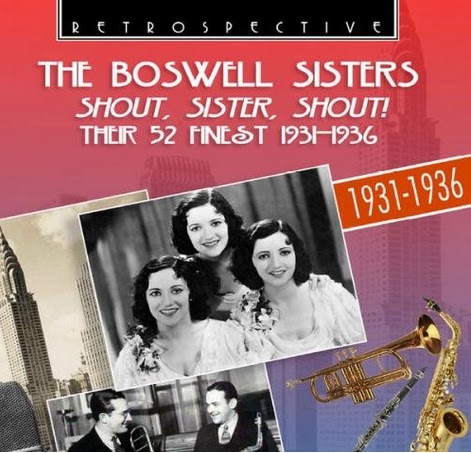
Wrote about The Boswell Sisters, three gals linked in sweet harmony, back in 2011 upon hearing about a documentary covering their illustrious career. To some degree, nobody has quite accomplished what the vocal trio did before or since - although many have tried!
High on the long list of New Orleans' finest musical talent, the fabulous Boswell Sisters, Martha (1905 - 1958), Connee (1907 - 1976) and Vet (1911 - 1988) were a truly groundbreaking act.
With Glenn Miller charts and the skilled backing of New York session musicians Benny Goodman, Bunny Berigan, Tommy & Jimmy Dorsey, Carl Kress, Eddie Lang and Joe Venuti, The Boswell Sisters recorded numerous sprightly tunes for Okeh and Brunswick.
They waxed great song after great song, as did their early 1930's contemporaries - Satchmo, Duke, Fats Waller, Cab Calloway, Earl "Fatha" Hines, Coleman Hawkins, Fletcher Henderson And His Orchestra and Don Redman.
They were certainly among the advance guard in their early career on radio and recordings, possibly were the first vocalists to tackle the songs of Duke Ellington.
Back to the documentary, the Kickstarter fundraiser for Close Harmony was successful and recent rumblings indicate that production is on a roll. It's highly likely to include at least one clip of the Bozzies singing Rock And Roll!
From the Facebook page by the documentary filmmakers, Joshua Tree Productions: "It's been too long since we've updated anyone here, but we've been very busy and are progressing steadily, even rapidly now."
"There's a lot of exciting things happening, some of which we can't yet talk about in a public forum yet. But, today we were making a presentation to a group of fans at the Historic New Orleans Collection as a part of the "Boswell Sisters, Their Music Goes Round and Round" symposium. We will now be spending the next two days recording material HNOC has graciously allowed us to use. It's a huge accomplishment for us, and we are enormously grateful to them."
We wish the filmmakers well and thank them for the following still of Bing and the Bozzies, posted on their website.
Music fans around the world await the completed film. Here's "The Boswell Sisters: Close Harmony" trailer on Vimeo.
Think there's a good bet material on other New Orleans greats - Louis Armstrong, Sidney Bechet, Henry "Red" Allen, Irma Thomas, Fats Domino, Guitar Slim, Dr. John, James Booker, Professor Longhair, Harry Connick Jr., all variations on The Meters, Radiators and The Wild Tchoupitoulas, Allen Toussaint, Ed Blackwell, The Marsalis Family, The Batistes, The Nevilles, Donald Harrison, Terence Blanchard and Nicolas Payton, to name a few - will be found there.
Today's post begins with a question: what happened in 1929? Well, for starters, The Jazz Age a.k.a. Roaring Twenties ended with a thud, of more accurately, a series of dull thuds caused by Wall Street speculators and ordinary folks who lost everything jumping out of tall buildings, thus, giving new meaning to the phrase "pounding the pavement".
People up and down the society, in all walks of life, had the blues. The balm in hard times? Such virtuosos of the blues as Bessie Smith, who made her first and last silver screen appearance in a 1929 short.
Composer-bandleader-pianist Duke Ellington was also featured in a 1929 musical short subject, Black And Tan Fantasy, co-starring dancer Fredi Washington. Duke, who had recorded with The Washingtonians as early as 1924, had been developing an original and sophisticated approach to how to write and arrange for varying sizes of ensembles (from septet to orchestra), which would continue evolving and changing through his six decades in music.
In April 1930, Universal Pictures released its musical "revue" flick The King Of Jazz, starring
The Paul Whiteman Orchestra, but it would be six months later, on October 25 when the real "shot around the world" of jazz on the silver screen transpired: the first appearance by an African-American band and reference to the Harlem Renaissance in a feature film, RKO Radio Pictures' Check And Double Check.
While an enormous box-office hit, this vehicle for radio stars Freeman Gosden & Charles Correll (a.k.a. "Sam & Henry", then "Amos N' Andy") and pert silent movie ingenue Sue Carol has not aged well.
A fair amount of this is because comedians Gosden and Correll, at that time and into the 1940's the biggest thing on the airwaves, appear in blackface throughout. Another reason: difficulties in translating the specific cadences and approach of radio, in which the character relationships are more fully delineated and the listener supplies the visual element, to movies.
RE: Gosden and Correll and blackface in general - the phrase "excruciatingly unfunny dialect humor" comes to mind - it frequently leaves even seasoned, seen-everything, grizzled and dyed-in-the-wool historians scratching our heads in utter bewilderment and asking repeatedly why the audiences of 1930 found THIS funny (note, for answers to that question, watch this documentary).
That said, in this otherwise retrograde RKO Radio Pictures comedy, we see the future - and that future is the cutting-edge Cotton Club Orchestra!
In the "Three Little Words" number, the dubbed singing voices of The Rhythm Boys, featuring pop-sensation-to-be Bing Crosby, can also be heard. So the musical segment of Check And Double Check includes Bing and Sir Duke, dynamos who would grace numerous musical short subjects, television shows and feature films over the next four decades.
Now, musical short subjects were nothing new by the time The Singing Kid and The Broadway Melody were runaway hits. The DeForest Phono Films and Vitaphone Varieties had already played theaters well the first wave of all talking, all singing, all dancing feature films hit the neighborhood houses and metropolitan movie palaces like a showgirl-filled tidal wave in 1929.
Always interested in the latest technological advances, producer-mogul William Fox, eager to market the Movietone sound-on-film technology as the alternative to Vitaphone's sound-on-disc system, produced newsreels and comedies as early as 1927-1928 (note: for more, read Movietone's Synchronized Shorts and Features). The Fox short subjects included the Movietone Musicals series, presumably the studio's answer to the Vitaphone Varieties. One of the Fox Movietone Musicals, many of which were directed by Marcel Silver, starred Beatrice Lillie, while others included the film debuts of Ruby Keeler and Winnie Lightner.
Fox also commenced a series, beginning with musical comedy shorts, headlined by the comedy team that starred on Broadway in The Ramblers, lecherous wiseguys Bobby Clark and Paul McCullough.
The Belle Of Samoa, one of the two existing Fox short subjects of Clark & McCullough, is a musical and somewhat in the school of the "revue" films. Co-starring stage and silent movie actress Lois Moran (known for her key role in Henry King's 1925 version of Stella Dallas) and a troupe of Hawaiian dancers with the wacky comedy team, it was intended to be included in Fox Movietone Follies Of 1929, but released as a short subject instead.
Seen today, The Belle Of Samoa presents a time capsule capturing vaudeville, Broadway and burlesque - and at this juncture remains the sole existing footage shot for Fox Movietone Follies Of 1929 a.k.a. William Fox Movietone Follies Of 1929.
As the Clark & McCullough series continued, it would appear that directors Harry Sweet and Norman Taurog did not employ the musical and "revue" format again. The series of featurettes and shorts also co-starred such ubiquitous comedy supporting players as Marjorie Beebe, Florence Lake and Otto Fries.
After shooting the last of the 15 comedies for Fox, Clark & McCullough returned to Broadway to appear in George Gershwin's Strike Up The Band. Films became something the comedy team did to make a buck between their Broadway engagements.
After Vitaphone and Fox, the next studio to plunge full force into musical short subjects would be would be Paramount Pictures, in 1928. Adolph Zukor's organization hit the ground running and began making numerous tuneful 1-reelers.
The stars: everything from everything from purveyors of humorous songs The Yacht Club Boys and Borrah Minevitch & His Harmonica Rascals to such iconic performers as Sophie Tucker (soon to star in her own feature-length vehicle, Honky Tonk) and George White Scandals star Frances Williams.
Eddie Cantor, who unquestionably liked his work, starred in Paramount short subjects before and after he was headlining feature films for Sam Goldwyn.
Unfortunately, in quite a few of the early talkies from Paramount, such as A Ziegfeld Midnight Frolic, starring Eddie Cantor and a series of five short subjects featuring vaudeville and burlesque eccentric dancer/singer/dialect comic James Barton (noted in Constance Valis Hill's Tap Dancing America book), the order of the day is . . . minstrelsy, the burnt cork routine, still all the rage in entertainment when the movies made the painful transition from silents to talkies in 1926-1929. After all, Cantor's big showbiz break was his first blackface character was in Gus Edwards' Kiddie Kabaret), and, at the same time, even Bert Williams, the Trinidad-born comedy star of the Ziegfeld Follies, used the burnt cork for his movie appearances.
Even with some historical perspective regarding what was going in on the society as a whole back in those days, 85 years later, in 2014, no getting around it, that staple of vaudeville looks bad, very bad.
The second of the five James Barton 2-reelers, After Seben, plops the racism right in front of us latter-day viewers while also serving up historic footage; the dance contest that comprises the second reel features bandleader-drummer-avatar-powerhouse Chick Webb, as well as truly stellar footwork by Barton - who demonstrates the origins of the "moonwalk" - and the amazing "Shorty George" Snowden.
So strap on those industrial strength May 18, 1929 goggles tight, plunge into another time capsule and see why Bing Crosby singled out James Barton, who readers may recall from the 1948 film adaptation of William Saroyan's The Time Of Your Life as one of the top vaudeville performers, as well as why Fred Astaire extolled the terpsichorean talents of Shorty George.
Ultimately, the Paramount musical shorts start finding consistency and charm as a direct result of the rise to prominence by sprightly and original vocal groups. One of the best and brightest was The Boswell Sisters, who appeared in 1-reel musicals and Big Broadcast features for Paramount and also enthusiastically contributed their lilting yet swinging 3-part vocal harmonies to the Fleischer Studio's "Screen Song" cartoons (a.k.a. Follow The Bouncing Ball).
Hearing the Bozzies (Connee, Martha and Vet), the line that extends to Ella Fitzgerald, The Andrews Sisters, The Platters, The Four Freshmen, The Hi-Los, The Four Seasons, The Beach Boys and The Roches is obvious - and a beautiful thing.
At Vitaphone, director Roy Mack must have helmed 500 musical comedies and big band shorts, before finishing his career with some of the earliest Soundies in 1941. Since film producers who ignored the growing popularity and staying power of jazz did so at their own peril, among the dozens of musicals and band shorts Mack cranked out were historic films starring, at long last featuring legendary African-American performers as the headliners. First up, the fabulous Cora Lee Redd, featured vocalist with The Noble Sissle Orchestra (who had previously starred in a DeForest Phono Film), in this clip from That's The Spirit.
Smash Your Baggage showcases a host of incredible dancers and vocalists.
Next, a Vitaphone 1-reeler co-starring the groundbreaking singer and actress Ethel Waters with a child star who would grow up to be arguably the greatest pure entertainer of his generation, actor-dancer-singer-impressionist Sammy Davis, Jr.
Clearly desiring to corner the market on tap dancers, Vitaphone also signed teenage hoofers Hal LeRoy and Mitzi Mayfair. Ms. Mayfair, having demonstrated considerable dancing skills in her Paramount On Parade appearance at the age of 15, captured the attention of Vitaphone short subject producer Sam Sax and soon was teamed with tappin' Hal for a series of musical shorts, starting in 1931.
The plots are the same, there's absolutely zero pre-Code risque/weird WTF factor, Hal's essential dialogue is "aw shucks - let's dance", but who cares - the young duo danced with a joy that carries the day.
Any hokeyness and clubfooted acting is invariably mitigated by the sheer earnestness, enthusiasm and likability of the tap dancing stars.
One inexplicable realization is that the most peculiar of all the early 1930's mini-musicals were made by big-budget MGM, the "Tiffany" of movie studios. Metro-Goldwyn-Mayer produced such Oscar-winning prestige pictures as Grand Hotel, but also were responsible for Jules White's Dogville comedies.
Actually, it shouldn't be THAT much of a shocker that the same studio that produced Cecil B. DeMille's pre-Code feature (and Exhibit A in the That's WTF department), Madam Satan, starring Kay Johnson in a goofy devil costume and, at one point in the epic's (ouch) climax, showgirls jumping out of dirigibles, also made the weirdest musicals that were not Fleischer Studio cartoons.
Producer Jack Cummings, later a key figure at MGM, directed several of the wildest 1-reel and 2-reel musicals, including this short subject, Crazy House and a bunch of hodgepodges that alternated 1929 musical numbers with wraparound segments starring Ted Healy & His Stooges. The following remains most notable for this bit of fancy dancing, completely unrelated to the rest of the film, by Earl "Snake Hips" Tucker, who lives up to his moniker and then some.
The remaining cast of Crazy House (no relation to the 1943 Universal feature starring the Helzapoppin' comedy team of Ole Olsen & Chic Johnson) also includes a motley crew of performers and comics - Cliff "Ukelele Ike" Edwards, wisecracking Benny Rubin, slapstick queen Polly Moran, Broadway comedian Gus Shy and character actors Karl Dane and (that favorite nemesis from Three Stooges and Harry Langdon comedies) Vernon Dent. Here's Crazy House, in its entirety.
Meanwhile, as the Depression wore on. . . and on. . . and on, MGM's downright bizarre 1-reel and 2-reel musical short subjects got weirder and wilder.
Some of the pre-Code bacchanals must be seen to be believed. In this clip from Wild People, the spunky and inimitable Eleanor Thatcher sings her heart out while Joyzelle Joyner prowls around the set as The Panther Lady. The supporting dancers and Joyzelle all wear wigs that would have been totally appropriate had they been able to time-travel and audition for backup singer gigs in Sly & The Family Stone 34 years later.
Over The Counter presents an unbeatable mix of veteran character actors (Franklin Pangborn), undulating showgirls, questionable taste, pointless grotesquery and the most ridiculously unsubtle phallic imagery ever seen in a motion picture. Ms. Thatcher sings "Check Your Husband" with chutzpah.
Eleanor Thatcher, the pride of Binghamton, New York, subsequently got fired by MGM and, very likely - as Buster Keaton no doubt was - kicked in the butt with a gentle "you have no talent and don't let the door hit you on the way out" insult as she left.
To some degree, due to the 21st century presence of YouTube, Eleanor got the last laugh. When Ms. Thatcher busts a move using that great wiggling riff of hers, as she does here in her third (and last) silver screen appearance in the independent "juveniles gone wild" film The Road To Ruin, it's pretty darn entertaining. Take that, MGM corporate!
All of the aforementioned material represents merely the tip of the iceberg regarding musical short subjects of the late 1920's and early 1930's. Part 5 of this series shall pay tribute to our dear celluloid pals, Busby, Ruby and Marlene - with a passing mention to the cartoon shorts that didn't make it to this post and starred Betty.
When reflecting on the many splendid musical talents from New Orleans – and the mere thought of Louis Armstrong, Sidney Bechet, Henry "Red" Allen, Irma Thomas, Fats Domino, Guitar Slim, Dr. John, James Black, James Booker, Professor Longhair, all variations on The Meters, Radiators and The Wild Tchoupitoulas, Allen Toussaint, Ed Blackwell, The Marsalises, The Batistes, The Nevilles, Donald Harrison, Terence Blanchard, Nicholas Payton and swingin’ Harry Connick Jr. brings a big, fat, deep-in-the soul smile to my face – don't forget the fabulous Boswell Sisters: Martha (1905 - 1958), Connee (1907 - 1976) and Vet (1911 - 1988).
With Glenn Miller arrangements and the skilled backing of New York's finest session musicians - Benny Goodman, Bunny Berigan, Tommy & Jimmy Dorsey, Carl Kress, Eddie Lang, Joe Venuti, etc. - The Boswell Sisters recorded numerous sprightly tunes for Okeh and Brunswick.
Like their contemporaries - Satchmo, Fats, Cab, Basie, Billie, Django, Duke, Earl "Fatha" Hines, etc. - they made recordings that swing like mad and still sound great 80 years later!
Here are The Boswells at the top of their game, in The Big Broadcast Of 1932, a wonderful Paramount Pictures musical that also features the original Swooner Crooner himself, Mr. Bing Crosby. Swing it, Boswell Sisters!
Three cheers for The Boswell Sisters, three gals linked in sweet harmony.