Thinking, as we do often, of movie comedians who successfully transitioned from silents to talkies.
Some studios and funmakers did better than others. Mack Sennett had his problems adapting to the new medium but did employ the likes of Harry Gribbon, Vernon Dent and Andy Clyde - and a couple of years later, the brilliant W.C. Fields.
Next: comediennes in early talkies, led by the following bravura performance of Marie Dressler in Hollywood Revue Of 1929. She must have been devastatingly great on stage!
Marie & Polly Moran both made Mack Sennett comedies back in the WW1 era and actually worked as a comedy team in 1927-1931 MGM features. Here they are in the Al Christie talkie DANGEROUS FEMALES.
Another actress who got big laughs in both silents and talkies was "baggy pants comedienne" Louise Fazenda, former star of Universal Joker, Mack Sennett and Educational (Jack White) Comedies - and later a key supporting player in Warner Bros. musicals. She plays a Calamity Jane gunslinger type in the following "when men were men and sheep were nervous" scenario.
While the spotlight on silent movie comediennes who successfully transitioned to sound should definitely include Marion Davies, there are no short excerpts from her early talkies available via YouTube, Daily Motion and Internet Archive, just complete features. Alas, Mabel Normand, Wanda Wiley and Alice Howell did not make any sound movies. Have read that Fay Tincher's last film, All Wet (1930), was a Universal Pictures talkie 2-reeler starring Syd Saylor, but have never seen it.
Then there's Educational Pictures, which featured the often inspired and memorable comic Lloyd "Ham" Hamilton
The Lloyd Hamilton Talking Comedies would be his second run with E,W, Hammons' Educational, the prolific comedy films distributor, starting in 1929.
Lloyd Hamilton's sound pictures from 1929-1931 represent a comeback after a stretch in which personal problems including multiple injuries, homelessness, unfortunate presence at drunken brawls and hard partying in general got him banned from the screen for a year.
In Toot Sweet, Hamilton does a good job of bringing his unrelentingly snakebit, shabby sad sack character from silents to sound.
Don't Be Nervous, featuring Ham in a dual role, would be my favorite of the Lloyd Hamilton Talking Comedies, along with the extremely funny Prize Puppies from 1930.
Hamilton continued starring in very funny talkie 2-reelers through the early 1931 Educational releases.
Before his decades as a megastar of British movies and stage shows (Me & My Girl), Lupino Lane starred in short comedies through the teens and twenties. As was the case with Lloyd Hamilton, he adapts to sound quite well.
A favorite of the musical comedy aficionados at Way Too Damn Lazy To Write A Blog remains this very wacky number co-starring the ever-charming Lillian Roth with the ever-tumbling Lupino, as always a gifted physical comedian, from the Ernst Lubitsch feature The Love Parade.
Now it's on to the Hal Roach Studio. A bunch of the Lot Of Fun stars and stock company members, including Max Davidson, Thelma Todd and Eddie Dunn appear together in this Edgar Kennedy 2-reeler.
100 years after his heydey, Harry Langdon remains both among the funniest and most polarizing of all movie comedians.
The gang here are among the few who are not only okay with Langdon's utter oddity and consider it his m.o. as a performer, but actually find his much maligned Hal Roach talkies quite funny in a very unorthodox way.
Devoted an entire post to these films - here's one of them!
Robert McGowan created the Our Gang series and helmed the films in silents by speaking the directions to the child actors, so these first talkies, in which he absolutely could not do that, are fascinating.
They are also interesting in blending the series' silent era stars, a.k.a. Hal Roach's Rascals, with the group that would increasingly carry the first season of sound Our Gang comedies.
Can't omit Laurel & Hardy from this mix. Berth Marks is notable for establishing something of a Guinness World Record for the amount of screen time devoted to one bit. The unrelentingly claustrophobic scene in the Pullman car features rather amazing extended physical comedy by Stan & Babe.
Our favorite of this bunch of early talkie comedies by far is Charley Chase and Thelma Todd in CRAZY FEET!
Are Charley and Thelma irreverent, extremely goofy and hilarious? Yes.
Acknowledgments: Weirdo Video, Geno Cuddy, Ralph Celentano, The Library of Congress, Dave Glass and all those involved at Sprocket Vault (Kit Parker, Richard M. Roberts especially) in making the 1929 Hal Roach talkies available on Blu-ray and DVD.
Yes, that's right, April Fool (1920) is a silent, but watch this great movie comedian, Lloyd Hamilton, directed by another great movie comedian, Charley Chase (a.k.a. Charles Parrott) work. Thanks to Huntley Film Archives for posting this!
As the thematic bent of this blog for the past few weeks has been silent comedy and silent movies - and the Niles Essanay Silent Film Museum will be presenting their annual Charlie Chaplin Days event this coming weekend - we're pleased as perky pomegranates to support another fundraiser which will bring more vintage silent era comedy goodness to DVD.
This time around, the Kickstarter is not on behalf of Marcel Perez a.k.a. The International Mirth-maker, but to bring to DVD six rare surviving short subjects starring the sad sack schlemiel with the checkered cap and the waddling duck walk, Lloyd Hamilton.
Hamilton's perpetually "born under a bad sign" character is reminiscent of Gleason's "The Poor Soul" (which could be described as 1/3 Gleason, 1/3 Lloyd Hamilton and 1/3 Harry Langdon) albeit a lot crankier, as well as a bit of a rake and a scoundrel.
This campaign originates from Great Britain and historian Dave Glass, in association with Dave Wyatt. Mr. Glass writes: "Hamilton’s comedy style was truly original. Like Harry Langdon’s, it was nuanced and reaction-based, but much more sardonic than any of the major comics.
Each film saw him stumble from catastrophe to calamity, hopelessly trying to maintain his ill-fitting sense of dignity and superiority. Chaplin, Keaton and Sennett all remembered him in later years as a major talent, but the majority of his films are lost, so this chance to see his films on DVD is a not-to-be-missed opportunity.
The disc will be Region Free and made to NTSC (USA standard) which also plays on UK/Euro machines. They will be mastered from 16mm prints which will be scanned digitally to provide the best possible quality and gently restored where necessary."
The films to be featured include the following four Mermaid Comedies produced in 1920 by Jack White (known to Three Stooges fans as "Preston Black") for Astra Pictures:
Dynamite (note - "blacking up" was such a common show business practice in the late 19th and early 20th century that Trinidad-born Ziegfeld Follies comedy star Bert Williams wore blackface on stage - and, if this ad is any indication, few actors besides Williams were more ill-suited to blackface than Lloyd Hamilton)
Moonshine as well was directed by Charley Chase and even features the future Hal Roach Studios star in a small role.
Also on the DVD, the recently rediscovered 1919 Lloyd Hamilton Fox comedy, His Musical Sneeze, courtesy of the Danish Film Institute.
The gags involving a wascally Bugs Bunny style rabbit make one wonder if Tex Avery happened to catch this 2-reeler as the comedy short subject before the feature film at a Taylor, TX movie palace.
There will also be A Home Made Man, a 1928 entry from the Hamilton Comedies series produced by Educational Pictures.
Extending a Happy New Year tip of the Jimmie Hatlo top hat to Undercrank Productions, for the following classic comedy featuring one of the very best of the non-Big Three silent film comedians, Lloyd Hamilton.
Following up the last post about Steve Massa's new book, here are some more imaginative bits of classic comedy goodness from the days of silent pictures.
First and foremost: Mr. Lloyd "Ham" Hamilton.
Marcel Perez, A.K.A. Tweedy and Tweedledum, among that first wave of screen comedians (along with Andre Deed and Max Linder) is becoming a favorite at Way Too Damn Lazy To Write A Blog. Not many Perez films survive (he died in 1929), but those that do show a highly creative and original comic mind.
Perez' sense of humor is wacky, surreal, outrageous and a bit risque, by comparison to American comedies from the same period. Here are examples of Perez' early Robinet series.
The aforementioned and always dapper Max Linder was one of the greatest movie comedians who ever lived and, like Perez, preceded Chaplin as a star of his own short subjects series, befire going on to feature films.
Watching 1941, Stephen Spielberg's effects-laden epic (in the vein of Stanley Kramer's It's A Mad Mad Mad Mad World and Blake Edwards' The Great Race) on Turner Classic Movies last night, I couldn't help thinking of Larry Semon, the prolific silent film comedian, director and cartoonist who loved sight gags on an operatic scale.
Mr. Semon would have adored 1941, still the last word in epic cartoonish set pieces and "mass destruction of property is good for a laugh".
Semon began his career directing and writing films for other comedians at Vitagraph, including the team of Earl Montgomery and (future comedy film producer) Joe Rock.
In retrospect, it's too bad Semon, who died in 1928, didn't live long enough to write gags for animated cartoons in talkies. One could imagine him dreaming up way-out stuff for Van Beuren, Fleischer or Terrytoons.
Here's Larry at his manic peak, supported deftly by, among others, Stan Laurel and Oliver Hardy.
Mr. Massa, as classic film buffs are well aware, programmed the Silent Clowns and Cruel & Unusual Comedy film series at The Museum Of Modern Art in collaboration with historian/accompanist/archivist Ben Model and is the curator of the Billy Rose Theatre Collection at the New York Public Library for the Performing Arts at Lincoln Center. Both Steve and Ben have forgotten more about silent film humor and history than most of us will ever know.
In an exceptionally well-researched tome, silent screen headliners Marie Dressler, Max Linder, Al St. John, Alice Howell, Fay Tincher, Marcel Perez, Gale Henry, Max Davidson, stage star turned Vitagraph Pictures comedienne Josie Sadler, Educational Pictures "thrills, spills and chills" specialist Lige Conley, ubiquitous Roach Studio background player George Rowe (A.K.A. the cross-eyed comic not named Ben Turpin) and many more at long last get their due.
The chapters on comedy teams are quite illuminating. A decade before the debut of Laurel & Hardy as a team, Eddie Lyons and Lee Moran made dozens of sophisticated farces with just a hint of slapstick and cartoonish humor for Nestor and Universal.
Also getting their due are some of the most aggressively bizarre and notoriously iconoclastic silent era comedians, including the Mean Misanthrope Of Mean Misanthropes and principal L-KO studio star, Billie Ritchie, A.K.A. "The Man From Nowhere".
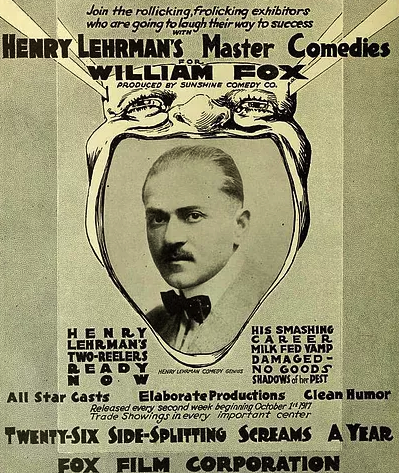
The architect of the series: The Dark Lord of nihilistic silent screen humor and former Sennett Studio director, as well as an unrelenting foe of minimal personal safety precautions for film actors, the infamous Henry "Suicide" Lehrman (whose brand name, Lehrman Knock-Out Comedies, also accurately described injuries suffered on the set by too many cast members and extras).
Billie Ritchie has been wrongly (yet repeatedly) identified as a Chaplin imitator for many decades, even though the two only had the derby/shabby suit/cane outfit and Fred Karno Troupe training in common.
While the getup, hairdo and mustache that Ritchie and Charlie Chaplin use are indeed identical, the characterizations and signature mannerisms could not be more different. Ritchie, an ever-confrontational mean bastard, struts, juts, flips off everyone and jumps around like a crazy man in such films as Just A Scandal - and could not be farther stylistically from Chaplin's rowdy yet increasingly balletic approach to 1915-1916 style slapstick.
While on the one hand, the Billie Ritchie m.o. is "lowdown-est slimiest starring character in the history of comedy films", on the other hand, there's something weirdly and savagely funny in the The Man From Nowhere's shameless, brazen and unending pursuit of booze, married dames and ill-gotten gains.
Bear in mind, the year 1915 unleashed a veritable barrage of "sick humor" (not to be seen again until the unapologetic "bad taste" of National Lampoon magazine 55 years later), led in the fullest anal sense by Billie Ritchie's vile nastiness, Kalem's disgusting anti-team of Ham & Bud, the early Rolin Co. knockabout 1-reelers starring an unrecognizable Harold Lloyd as raucous Lonesome Luke and Essanay's appalling yet fascinating "greasepaint meets surrealism" Mishaps Of Musty Suffer series, starring Harry Watson, Jr.
So even the most nose-thumbing, derriere-kicking, brick-heaving early Chaplin at Keystone and Essanay is a far cry from the insanity of these series.
Massa compares the vile and bilious Lehrman comedies anti-protagonist to a controversial comedian/actor from many decades later, the chaos-loving Andy Kaufman, in their shared sense of provoking audience hatred while enjoying spreading unmitigated mayhem (although, frankly, Mr. Kaufman in his most gleefully anarchic "performance art" form seems like quite the sweetheart by comparison to Billie Ritchie's scoundrel characterization - and besides, Andy's Latka/Foreign Man character strikes this correspondent as his personal riff on the post-1929 Harry Langdon).
Now, curiously enough, one of the former Sennett Studio comedy creators who found his way to the historically important yet utterly misbegotten L-KO studio gets the spotlight for his remarkable work as a prolific director of everything from slapstick to genteel farce.
After directing a gazillion comedy shorts for every studio around from 1916-1924, Chase began his own starring series at Hal Roach, producing masterpiece after masterpiece - and, unlike most of his contemporaries, carrying that formidable comedy mojo well into the sound era: most notably in several tremendously funny, romantic and charming farces co-starring the most beautiful, talented comedienne whose name was not Carole Lombard, the underrated Thelma Todd. Author James L. Neibaur, who seems to finish a new, crisply written, informative and enjoyable film history book about every 5 minutes, has done it yet again in 2013 with his upcoming study of Charley Chase's sound films.
When it comes to movie comedy history, Ladies and Gentlemen, we are in the midst of a renaissance. This includes Steve's tome, Michael Hayde and Chuck Harter's book on the great Harry Langdon, Anthony Balducci's biography of brilliant silent and early sound era comedian Lloyd Hamilton, studies Trav S.D. has penned about classic movies and vaudeville, PLUS the first volume, Smileage Guaranteed, of what will be an extensive "no available rare footage left unscreened" comedy film history series by Richard M. Roberts and more. Also in the pipeline: Annichen Skaren's biography covering the life, times and films of Al St. John and Mr. Blogmeister's most Psychotronic meditations on multi-genre movie mayhem, That's Not Art!
To order these books - and thus, enroll in an advanced course of study in The College Of Classic Comedy Knowledge:
There are more worthy books on the topic of silent comedy that are no longer in print, but definitely still available via Kindle.
With respectful tips of the Jimmie Hatlo/Fred Astaire/Jack Buchanan top hat to Sam Gill and Leonard Maltin, we at Way Too Damn Lazy To Write A Blog are now going to take a break and watch some cool vintage silent comedies. Cheers!