Large Association of Movie Blogs
Showing posts with label Al St. John. Show all posts

Saturday, May 12, 2018

Locomotion Cinema


Watching Richard Fleischer's amazing thriller The Narrow Margin on TCM's Noir Alley recently, realized that Way Too Damn Lazy To Write A Blog has never devoted an entire post to movies with trains in them or set on trains. Fritzi Kramer of Movies Silently wrote an entertaining post on the origins of the Silent Movie Myth: Tied to the Railroad Tracks - that damsel in distress image from stage, deftly spoofed both by the likes of Mack Sennett's studio and, 45 years later, Jay Ward's Dudley Do-right of the Mounties cartoons - so by golly, we'll give this the old college try, starting with a musical interlude!


Since one of the first American-made movies to be a boffo hit was Edwin S. Porter's The Great Train Robbery, this sounds like a plan. So let's do the locomotion, first with Bulgarian-French Scopitone queen Sylvie Vartan.


Shifting from French Scopitones to animation, The Fleischer studio made lots of cartoons on trains over nearly 30 years in production, including many that preceded talkies. One of the numerous cartoons from the Fleischer studio's late 1920's Inkwell Imps series, Koko's Toot Toot, features Koko The Clown as an engineer.


Kitty From Kansas City, a 1931 Max Fleischer Screen Song cartoon, stars the one, the only Betty Boop and features crooner/comedian/actor Rudy Vallee.


Betty hosts her own train in The Betty Boop Limited, at least the second train cartoon - well, that we know of - featuring Betty. We assume Miriam Hopkins didn't want the job - and we are certain Marlene Dietrich and Josef von Sternberg were NOT interested, either! La Boop, under contract to Paramount Pictures, no doubt had to do this cartoon, since the Fleischer Studio's #1 rival Walt Disney and ace animator Un Iwerks had already made Mickey's Choo-Choo in 1929.


In addition, Disney made at least one train cartoon prior to Mickey's Choo-Choo. That would be the 1927 silent Hungry Hoboes, starring Oswald The Lucky Rabbit.


Since today's compendium of clips and cartoons will have one unifying factor, locomotives, we'll post arguably the greatest train cartoon ever made, the 1936 Max Fleischer Color Classic Play Safe, featuring the distinctive Fleischer visual style and a terrific score by Sammy Timberg.


There is a psychedelic quality to both the painted layouts and the 3-D tabletop sets a.k.a. the Fleischer setback camera technique throughout. The patented Fleischer 3-D effects in Play Safe are only surpassed by the studio's 1936 piece-de-resistance, Popeye The Sailor Meets Sindbad The Sailor.


Animation buffs have been arguing over The Fleischer Studio’s ‘Setback’ Camera vs. Disney realism for eight decades and maybe shall do this for at least eight more decades. Whether you prefer the Disney or Fleischer approaches, the multiplane camera or the revolving tabletop mini-sets, Play Safe remains one of the most imaginative cartoons to emerge from the Fleischer Studio.


As far as feature films set on trains go, this blogger's favorite, hands-down, remains Richard Fleischer's classic Narrow Margin, co-starring macho tough guy Charles McGraw with macho tough gal Marie Windsor. Yes, that's right - Richard Fleischer, son of Max Fleischer and nephew of Dave, the producers of the last three cartoons.


The very first train film this blogger was ever aware of was a silent movie starring comedian Monty Banks, Chasing Choo Choos. If Mr. Blogmeister remembers correctly, first saw this in one of the Robert Youngson comedy compilation features.


The Robert Youngson comedy compilation features, Laurel & Hardy’s Laughing 20's and Four Clowns in particular, constituted this writer's introduction to the films of The Hal Roach Studio.


There are so many Roach comedies involving trains - Get Out & Get Under, Now Or Never (Harold Lloyd), Berth Marks (Laurel & Hardy), Young Ironsides (Charley Chase), Sundown Limited, Railroadin’ and Choo-Choo (Our Gang) and Show Business (Thelma Todd & Zasu Pitts), just to name a few - it would take further posts to come close to getting into all of them.


A significant portion of one of the funniest of all Charley Chase talkies, Young Ironsides (1932), co-starring Muriel Evans, is notable for a hilarious scene that transpires on a train and features a recalcitrant green vegetable.


The mention of daredevil Harold Lloyd recalls another intrepid, triple-jointed acrobatic comedian from silents, Al St. John, who, very likely in response to John Ford's big budget epic of epics The Iron Horse, starred in the stellar silent comedy The Iron Mule. Roscoe Arbuckle, Al's uncle and frequent co-star (at Sennett and Comique) directed. And whenever there's a post-1922 Arbuckle and/or St. John picture, it's worth looking carefully for Buster Keaton, known to make cameo appearances in his friends' films.


And speaking of Buster Keaton, had the pleasure of seeing Buster's epic of epics to out-epic The Iron Horse, The General in one of the San Francisco Silent Film Festival programs and was completely, entirely blown away. If one is lucky enough to have an opportunity to see it on the big screen with an audience, don't miss it. The General is truly spectacular and loses a fair amount of its magic when viewed on the small screen.


One guy who very likely saw The Iron Horse, The Iron Mule and The General was cartoonist, animator and movie director Frank "Tish Tash" Tashlin. Among a slew of excellent Looney Tunes cartoons Tashlin directed, Porky's Railroad tackles the "modern vs. old reliable" storyline, bringing creative uses of pacing, editing, camera angles and great gags to the process.


Back to features, a big screen epic that very likely loses a great deal of its impact seen on TV, iPad or (God help us) smart phone is Cecil B. DeMille's 1939 Paramount opus Union Pacific, starring Barbara Stanwyck and Joel McCrea. Haven't seen it and thus cannot comment further with any authority or knowledge, but . . . WOW - the iconic Babs and McCrea are on hand and if the film is 1/10 as cool as the titles, it's movie fun exemplified. And besides, the Fleischers spoofed it with the Popeye cartoon Onion Pacific!


Out the same year as Union Pacific: one of the last British feature films of Alfred Hitchcock, The Lady Vanishes. Did Hitchcock have a thing about trains? Yes - both the prim Sir Alfred Hitchcock who made Number Seventeen and The Lady Vanishes and the not-so-prim Sir Alfred of Shadow Of A Doubt and Strangers On A Train. There are Hitch cameos three of the films!


Given that Hitchcock's 1936 feature Sabotage is not at all prim and in fact shockingly diabolical in its denouement, the character of Bruno Anthony in Strangers On A Train, played brilliantly by Robert Walker, remains the personification of the all-American movie psychopath and just one among several in the Hitchcock catalog: bloodthirsty scum of the earth, yet unnervingly clever.


It was no accident that when Patricia Hitchcock made an in-person appearance at an SRO screening of Strangers On A Train at the Stanford Theatre in Palo Alto, CA many years ago (but decades after the film's original theatrical release), the line ran around the block!


Now just what the link between The Master Of Suspense and mid-1960's pop music is, we don't know, have no idea, but while this blogmeister can't remember a specific episode of The Monkees TV show that takes place on a train offhand, what the hey, who cares, Last Train To Clarksville is a great tune - one of their best!


A fellow 1960's pop music star and recording artist, Little Eva, gets the last word on today's post.


Thursday, May 23, 2013

Classic Comedy Fans: Buy This Book!


This new release is a must-addition to the Comedy Buff Bookshelf: Lame Brains And Lunatics: The Good, The Bad And The Forgotten Of Silent Comedy by Steve Massa. The classic movie website Nitrateville has posted an interview about the book, an indispensable history of the lesser-known yet rewarding far corners of silver screen humor.


Mr. Massa, as classic film buffs are well aware, programmed the Silent Clowns and Cruel & Unusual Comedy film series at The Museum Of Modern Art in collaboration with historian/accompanist/archivist Ben Model and is the curator of the Billy Rose Theatre Collection at the New York Public Library for the Performing Arts at Lincoln Center. Both Steve and Ben have forgotten more about silent film humor and history than most of us will ever know.


In an exceptionally well-researched tome, silent screen headliners Marie Dressler, Max Linder, Al St. John, Alice Howell, Fay Tincher, Marcel Perez, Gale Henry, Max Davidson, stage star turned Vitagraph Pictures comedienne Josie Sadler, Educational Pictures "thrills, spills and chills" specialist Lige Conley, ubiquitous Roach Studio background player George Rowe (A.K.A. the cross-eyed comic not named Ben Turpin) and many more at long last get their due.


The chapters on comedy teams are quite illuminating. A decade before the debut of Laurel & Hardy as a team, Eddie Lyons and Lee Moran made dozens of sophisticated farces with just a hint of slapstick and cartoonish humor for Nestor and Universal.


Also getting their due are some of the most aggressively bizarre and notoriously iconoclastic silent era comedians, including the Mean Misanthrope Of Mean Misanthropes and principal L-KO studio star, Billie Ritchie, A.K.A. "The Man From Nowhere".


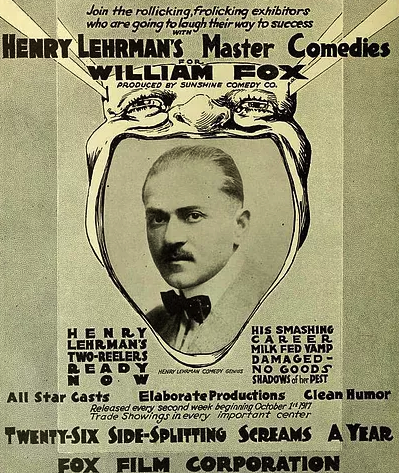
The architect of the series: The Dark Lord of nihilistic silent screen humor and former Sennett Studio director, as well as an unrelenting foe of minimal personal safety precautions for film actors, the infamous Henry "Suicide" Lehrman (whose brand name, Lehrman Knock-Out Comedies, also accurately described injuries suffered on the set by too many cast members and extras).


Billie Ritchie has been wrongly (yet repeatedly) identified as a Chaplin imitator for many decades, even though the two only had the derby/shabby suit/cane outfit and Fred Karno Troupe training in common.


While the getup, hairdo and mustache that Ritchie and Charlie Chaplin use are indeed identical, the characterizations and signature mannerisms could not be more different. Ritchie, an ever-confrontational mean bastard, struts, juts, flips off everyone and jumps around like a crazy man in such films as Just A Scandal - and could not be farther stylistically from Chaplin's rowdy yet increasingly balletic approach to 1915-1916 style slapstick.


While on the one hand, the Billie Ritchie m.o. is "lowdown-est slimiest starring character in the history of comedy films", on the other hand, there's something weirdly and savagely funny in the The Man From Nowhere's shameless, brazen and unending pursuit of booze, married dames and ill-gotten gains.


Bear in mind, the year 1915 unleashed a veritable barrage of "sick humor" (not to be seen again until the unapologetic "bad taste" of National Lampoon magazine 55 years later), led in the fullest anal sense by Billie Ritchie's vile nastiness, Kalem's disgusting anti-team of Ham & Bud, the early Rolin Co. knockabout 1-reelers starring an unrecognizable Harold Lloyd as raucous Lonesome Luke and Essanay's appalling yet fascinating "greasepaint meets surrealism" Mishaps Of Musty Suffer series, starring Harry Watson, Jr.


So even the most nose-thumbing, derriere-kicking, brick-heaving early Chaplin at Keystone and Essanay is a far cry from the insanity of these series.


Massa compares the vile and bilious Lehrman comedies anti-protagonist to a controversial comedian/actor from many decades later, the chaos-loving Andy Kaufman, in their shared sense of provoking audience hatred while enjoying spreading unmitigated mayhem (although, frankly, Mr. Kaufman in his most gleefully anarchic "performance art" form seems like quite the sweetheart by comparison to Billie Ritchie's scoundrel characterization - and besides, Andy's Latka/Foreign Man character strikes this correspondent as his personal riff on the post-1929 Harry Langdon).


Now, curiously enough, one of the former Sennett Studio comedy creators who found his way to the historically important yet utterly misbegotten L-KO studio gets the spotlight for his remarkable work as a prolific director of everything from slapstick to genteel farce.


That director would be Charles Parrott, soon to return to performing as Charley Chase and star in some of the very best silent film comedies. The chapter on Parrott's highly varied directorial career in Lame Brains And Lunatics: The Good, The Bad And The Forgotten Of Silent Comedy is in itself worth the price of admission.


After directing a gazillion comedy shorts for every studio around from 1916-1924, Chase began his own starring series at Hal Roach, producing masterpiece after masterpiece - and, unlike most of his contemporaries, carrying that formidable comedy mojo well into the sound era: most notably in several tremendously funny, romantic and charming farces co-starring the most beautiful, talented comedienne whose name was not Carole Lombard, the underrated Thelma Todd. Author James L. Neibaur, who seems to finish a new, crisply written, informative and enjoyable film history book about every 5 minutes, has done it yet again in 2013 with his upcoming study of Charley Chase's sound films.


When it comes to movie comedy history, Ladies and Gentlemen, we are in the midst of a renaissance. This includes Steve's tome, Michael Hayde and Chuck Harter's book on the great Harry Langdon, Anthony Balducci's biography of brilliant silent and early sound era comedian Lloyd Hamilton, studies Trav S.D. has penned about classic movies and vaudeville, PLUS the first volume, Smileage Guaranteed, of what will be an extensive "no available rare footage left unscreened" comedy film history series by Richard M. Roberts and more. Also in the pipeline: Annichen Skaren's biography covering the life, times and films of Al St. John and Mr. Blogmeister's most Psychotronic meditations on multi-genre movie mayhem, That's Not Art!

To order these books - and thus, enroll in an advanced course of study in The College Of Classic Comedy Knowledge:


There are more worthy books on the topic of silent comedy that are no longer in print, but definitely still available via Kindle.

With respectful tips of the Jimmie Hatlo/Fred Astaire/Jack Buchanan top hat to Sam Gill and Leonard Maltin, we at Way Too Damn Lazy To Write A Blog are now going to take a break and watch some cool vintage silent comedies. Cheers!


Monday, September 10, 2012

Happy Birthday, Al "Fuzzy" St. John by Paul F. Etcheverry

"He was terrific. Some of the stunts he did are unbelievable. No special effects in silent movies, he is really up that high and falling that hard." Jerry Lewis

"I had the greatest sidekick in westerns. Better than Gabby Hayes, better than Smiley Burnette. Al's career dated back to the old Keystone studios, and he could still do amazing stunt work. He helped choreograph fight scenes, helped other actors with their falls, and during the breaks he would tell wonderful stories about the silent movie days." Buster Crabbe


Born September 10, 1893, comedian, actor and acrobat Al St. John. He starred in dozens of comedy shorts with many studios and later on, as a supporting player in talkies, was the best of all the grizzled B-western sidekicks - after all, did you ever see Gabby Hayes dismount a horse and then do a backflip?


Al's unique ability to execute pure physical comedy with loose-limbed gusto, goofiness and hair-raising stuntman derring-do was only equaled by Al's Comique co-star Buster Keaton and England's triple-jointed king of the music halls, Lupino Lane.


Arguably, the acrobatic trifecta assembled for the Comique series - Roscoe Arbuckle, Buster Keaton and Al - was the greatest slapstick comedy lineup to ever work together onscreen.


Here's a 1914 Keystone Comedy co-starring Al with another great from the days of silent era slapstick, comedienne Alice Howell - the wacky redhead who preceded Lucille Ball by three decades, well known in silent comedy for her outrageous reactions and "Q-Tip" hairdo in Cinderella Cinders and other 1920's films.


It's a darn shame that, largely due to vault fires that claimed an incalculable chunk of film history, so many of Al's starring vehicles for Fox, Educational, Warner Brothers, Paramount and other studios remain rare and difficult to see.


Norwegian film researcher Annichen Skaren - who is writing a biography of Al - has done comedy fans and silent film buffs the favor of posting a fair amount of his surviving work on YouTube.


What's notable about Al, both in his slapstick comedy and later B-western incarnations, is how he repeatedly:
  1. Makes something out of nothing - A.K.A. low-budget be damned, let's do it!
  2. Brings out the unusual and surreal qualities out in any situation, no matter how humdrum. That skill was very likely taught to him by his talented uncle, Mack Sennett Studio star and writer-director Roscoe Arbuckle.


Case in point: the following early talkies Al starred in for Educational, Pathé and Paramount, respectively.


The Educational 1-reeler Western Knights was directed by Stephen Roberts - yes, indeedy, the same Stephen Roberts who directed the ultra-racy Miriam Hopkins vehicle The Story Of Temple Drake just a couple of years later.


In Two Fresh Eggs, clearly a Grade-Z production even in the low budget world of comedy shorts, Al is teamed with one of Vitagraph's principal silent era comedy stars, Jimmy Aubrey. It appears that the two comedians essentially shot some cheap wraparounds to support some even cheaper and unabashedly cheesy musical production numbers (presumably cutting room floor footage) from 1928-1929. Enjoy how Al, in this undistinguished 2-reeler, not only works harmoniously with the perpetually over-the-top Aubrey, but manages to totally steal the film in the process.


The comedy of Al St. John is also covered in the new book by film historian Anthony Balducci, Eighteen Comedians Of Silent Film and will be turning up from time to time in the TCM Mack Sennett retrospective this month.


Historian, author and comedy aficionado par excellence James L. Neibaur said it best: "Mack Sennett often made use of his many talents, from his ability to take amazing pratfalls to his prowess at playing any character. From large parts to small, Al St. John can be found as a strong protagonist, a frightened weakling, a romantic hero, a wily villain, a sneaky rival, or merely a slapstick presence in the background to bolster a scene. His wiry, limber body, his muscular strength, and his expressive facial manner were all perfect for the type of comics Sennett made the most use of, so Al worked regularly during his Keystone tenure. Al branched off as a solo artist, first at Paramount and then Warner Brothers before settling for a long period with Fox studios. What we can see from the existing examples is how Al continued to exhibit his versatility as a comic actor, how he continued to perform amazing stunts, and the impressive fact that he began exploring writing and directing, adding an auteurist approach to his work. Much of Al St. John's best work is among the maddeningly lost films of the silent screen, disallowing a full and complete assessment of his contribution to screen comedy."


And, until one can catch up on the TCM broadcasts via trusty DVR, here's Al in Dynamite Doggie and Out Of Place.


To the likes of Al, Buster Keaton, Roscoe Arbuckle and many more who quite literally risked their lives for the perfect sight gag, there aren't enough thanks. We're still laughing our you-know-whats off nearly a century later.


Tuesday, September 04, 2012

The Spice Of The Program, Part Two


Lloyd Hamilton and Mermaid Comedies producer/director/writer Jack White


One wonders just how Earle W. Hammons' Educational Pictures transitioned from riding high in the 1920's by distributing Otto Messmer's internationally popular Felix The Cat cartoons, classic silent comedies (many directed by the incredibly, mind-numbingly prolific Norman Taurog) starring Lloyd Hamilton, Al St. John, Lupino Lane, Larry Semon and Charley Bowers to a largely different roster and alarmingly low budget films in the 1930's.


Let's start with what happened to the studio's headliners. In 1923-1924, the principal star of Educational's Mermaid Comedies, silent comedy's favorite sourpuss, Lloyd Hamilton, attempted to branch out from his popular and acclaimed series of short subjects by starring in two feature length films.


One, A Self-Made Failure, directed by the ubiquitous William Beaudine, is a lost film. His Darker Self, originally titled Black And White, was designed by D.W. Griffith as a vehicle for stage star Al Jolson. When Jolson abruptly quit the project, Griffith asked Hamilton to replace him in the starring blackface role.


This was a bad career move, very bad idea and by all accounts - and if what footage exists is any indication - an even worse film.


After Hamilton returned to comedy shorts in 1926 and starred in such classics as Move Along, he was banned from making films for the entire 1928-1929 season. How? Hamilton and character actor Johnny Sinclair happened to be present when a certain barroom brawl took place in which pugilist Eddie Diggins was killed. Hamilton wasn't responsible for the stabbing death of Diggins, but his presence at the drunken donnybrook was enough to get him a one year ban from films.


The suspension was neither good for Educational nor the gifted yet booze-soaked comedian. At one point, Hamilton ended up homeless. The ban meant that an excellent opportunity to hit the ground running in a smooth transition to talkies was lost - and Hamilton's voice fitted his world-weary yet shabby genteel characterization to a T.

Al St. John?


Before re-inventing himself with panache as prolific western sidekick Fuzzy Q. Jones, Al continued to star in Mermaid Comedies, some directed by Stephen Roberts (later known for the ultra-racy pre-Code melodrama The Story Of Temple Drake) and moved into talkies without a hitch in Educational's Cameo Comedies series, many helmed by Roscoe "William Goodrich" Arbuckle. Even in the most threadbare of low budget 1-reelers, Al, ever the pro's pro, gets laughs.

Lupino Lane?


Only equaled by St. John and Buster Keaton as an acrobatic and gymnastic comedian-athlete, Lane, also a pro's pro, starred in his last U.S. comedy short subjects, including a few early talkies, in 1929.


After plum supporting roles in the musicals The Love Parade and Bride Of The Regiment, this brilliant physical comic appeared in one of the all-time bombs, Golden Dawn.


This early talkie musical was a golden turkey of golden turkeys, in spite of some very funny and spirited performances by Lane, Marion "Peanuts" Byron and Lee Moran.


Following the release of this 1930 stinker, Lane did what any reasonable actor would do, flee the U.S.  and return to the United Kingdom!


There, he would become an enormous star of the stage and enjoy renewed prestige as one of England's premier show business icons! Lupino Lane became the mainstay of the musical comedy smash Me And My Girl.


Larry Semon, the uncrowned king of prop comedy and elaborate sight gags, early 1920's style and key predecessor of "Three Stooges" style slapstick? Died in 1928. Although Semon's career had taken quite a bad turn since his heydey as the very popular star of lightning-paced, sight gag-filled Vitagraph shorts, his success in latter 1920's character roles (especially in Josef von Sternberg's gangster flick, Underworld) pointed towards a comeback. Unfortunately for Larry, a young man (39) at the time of his passing - and film history - that second act in sound films as a director, character actor, storyboard artist, animator, scenarist or gagman didn't happen.

The great stop-motion animator and reluctant 2-reeler star Charley Bowers?


Alas, the Bowers Comedies series, delighting the Dadaist/Surrealist movement in Paris while dumbfounding small-town movie audiences worldwide, officially ended in 1928 - and not without leaving some amazing imagery behind.


Bowers continued to sporadically function as an independent producer with such remarkable stop-motion films as the following early talkie, It's A Bird.


Bowers subsequently joined the story department of the Walter Lantz studio and produced occasional strikingly imaginative and bizarre stop-motion cartoons, but did not appear on-camera again.

So, as the 1920's ended, most of the Educational Pictures comedy stars had moved on - and the essential alliances also changed.


At the beginning of the decade, Hammons cut a deal to distribute the Al Christie Studio's "Torchy" series starring Johnny Hines around the same time he contracted with Jack White. Christie, who had supplied tons of comedy films to Educational Film Exchange, signed a three-year deal with Paramount starting with the 1926-1927 season.


Educational responded to the loss of the Al Christie Studio and its prolific short subjects production units by contracting with Mack Sennett.


Sennett's Fun Factory continued cranking out 2-reelers, first for Educational release, then later for Paramount. The best known Sennett talkies feature Andy Clyde and W.C. Fields. Other "Mack Sennett Star Comedies" include the last appearances of a rather haggard and spent looking Lloyd Hamilton, as well as comedienne Marjorie Beebe (who Lucille Ball must have been aware of).


Even cartoons were affected; Felix The Cat was lost to Jacques Kopstein and Copley Pictures - and Paul Terry's Terrytoons were lined up as the replacement.


We'll get into what the heck happened to Educational when the movie business made the painful transition between silents and talkies and the 1930's progressed in Part Three.