This blog will, as a misbehaving toddler would, be taking a time out; wish it were Dave Brubeck's Time Out and Time Further Out, but nonetheless we shall, like Bing in White Christmas, be counting our blessings. Today's post will be even sloppier than our usual offerings.
Until our return in June, here are cheesy print ads from the two most clicked-on posts from the 15 years of Way Too Damn Lazy To Write A Blog, starting with a brilliant bogus one from the fertile imagination of the king of fake retro ads, Cris Shapan.
Both of the most clicked-on posts were about cheesy print ads (real and fake). Here's a very clever fake from Jack Pollock's 1994 Devil Chef comic book.
Meanwhile, this (fake) Soda Pop Board of America ad makes me laugh out loud every time I see it.
While no variant of Potato Fudge took America by storm, no doubt Cris Shapan noticed that Kraft's actual canned spaghetti had some things in common with the super-starchy fake product.
Don't know who created this ad, although one suspects this is yet another Cris Shapan Special. It is, in fact, not far afield from other businesses Mickey launched over the years.
While wondering what the heck besides spuds were ingredients in a "potato shake," we note that Mickey Rooney's Star-B-Q and Weenie World, indeed, were actual ventures.
The good news: Madame Blogmeister, at long last, is home from the hospital and has already made a reference to the song It's A Hap Hap Happy Day (from the Fleischer Studio's Gulliver's Travels).
)
Also good news: this blog and blogger, knock on wood, shall return in a few weeks.
It is now spring 2022, knock on wood, and, slowly but surely (and puh-lease, don't call me Shirley) classic film screenings are returning. Lo and behold, NOIR CITY 19 and the 2022 TCM Classic Film Festival wrapped and San Francisco's 25th Silent Film Festival will return to the hallowed "movie palace" aisles of the Castro Theatre next weekend.
The comedy-crazed silent movie buffs at Way Too Damn Lazy To Write A Blog are thrilled that, among the many great movies presented over the seven nights, comedy great Max Linder is on the bill.
The 25th anniversary San Francisco Silent Film Festival will include KING OF THE CIRCUS, a Max Linder film this avid silent comedy and Max fan has never seen! While Linder may have not been the first comedian to star in a movie - that would very likely be André Deed (1879-1940) - the dapper Parisian boulevardier was certainly among the first silver screen comedians to headline a popular continuing series, in his case for Pathé Frères, beginning in 1905.
Max Linder certainly ranked highly among the key influences on his friend and colleague Charlie Chaplin.
Chaplin described Max as "my teacher."
The official SFSFF press release elaborates:
The French were there at the dawn of cinema when the Lumière Brothers train pulled into the station at La Ciotat. French films are integral to the history of the movies and it is with great pleasure—or should we say plaisir—that we are presenting two extraordinary French films in exquisite restorations, DANS LA NUIT and THE DIVINE VOYAGE, and a third restoration of an Austrian feature, KING OF THE CIRCUS, starring the French comic genius Max Linder.
DANS LA NUIT was legendary actor Charles Vanel's directorial debut—and his only feature. This beautiful film had the bad timing to be released in 1930, when sound was in demand. Despite its excellent reviews, the film faltered at the box office and was doomed to obscurity.
But it had many acclaimed supporters — director Bertrand Tavernier called it "cinematographic poetry" — and we are thrilled to host the world premiere of Institut Lumière's gorgeous new 4K restoration. Film Noir Foundation's Eddie Muller will introduce the film and musician Stephen Horne will accompany.
Our friends at Lobster Films in Paris have been busy during the pandemic lockdown and SFSFF is the beneficiary with two beautiful new restorations! Julian Duvivier's THE DIVINE VOYAGE, set on the Breton coast, contains some of the most stunning sequences on film. Guenter Buchwald and Frank Bockius will accompany.
KING OF THE CIRCUS is Max Linder's last film and it displays the comedic genius that made him one of the silent era's kings of comedy. Philip Carli will accompany. Serge Bromberg of Lobster Films will introduce both titles.
For more Max: the pioneering movie comedian's daughter, Maud, an infant at the time of his death in 1925, wrote, produced and narrated a documentary, The Man In The Silk Hat about the life, times and films of the father she never knew. Here it is, in four parts:
Immersion in the stand-up comedy of fallen heroes Gilbert and Bob lately has led, like a gateway drug, to today's Cornucopia of Clips focusing on sketch comedy.
With a note to blog readers that the Blogmeister is dealing with a host of challenging computer problems entirely of his own making, as well as the fact that Blogger does not have a functioning "Preview" (enabling one to actually see a post before it has been published), we kick this off with Sid Caesar and Imogene Coca on Admiral Broadway Revue and Your Show Of Shows.
And then there's Ernie Kovacs, remembered best for his remarkably inventive work, in front of and behind the camera, on his own TV shows. He was out of the box, WAY out of the box, but always the master of the "orthicon tube".
Across the pond from Ernie and a few years later, there was the one, the only Marty Feldman!
And, speaking of the Brits, there's Spike Milligan, co-creator of "The Goon Show."
Very likely the first time Americans saw Spike Milligan was on the short-lived but glorious 1970 sketch comedy show, The Marty Feldman Comedy Machine.
Spike co-starred and wrote sketches with an all-star crew including Marty and Barry Levinson.
Like Marty Feldman, he was a trumpet player who, instead of leading a British bebop big band, became a comedian.
The musical nature of Spike's writing proved a constant in his career as a performer and author.
The gang at Way Too Damn Lazy To Write A Blog, who do not consider it a stretch at all to compare Bob Odenkirk's comedy style to Spike Milligan, has been watching and listening to various interviews from the former Saturday Night Live, Ben Stiller Show and Mr. Show writer from his current book tour, including the April 17 appearance on Al Franken's podcast. Bob Odenkirk, on said book tour, is interviewed here by none other than the great Jack Black.
In the 21st century known for adding a wry sensibility to provocative, hard-hitting, tough-as-nails dramas (Breaking Bad, Better Call Saul) and unconventional action hero thrillers (Nobody), Bob Odenkirk began his career in the 1980's writing comedy sketches with Second City. We know him well from his role as Winston Deaver in Disney/Pixar's Incredibles 2.
Also know Mr. Odenkirk from his years writing for Saturday Night Live, along with a crew that included Conan O'Brien and Robert Smigel. The most famous SNL sketch he wrote would be the following.
In 1995-1998, Odenkirk and David Cross, supported by a host of comedy luminaries (John Ennis. Jay Johnston, Paul F. Tompkins, Jill Talley, Tom Kenny, Brian Posehn among the continuing players, Dino Stamatopoulos, Sarah Silverman and Jack Black as guest stars) produced four seasons of Mr. Show with Bob & David.
Mr. Show with Bob & David could be described as an American version of the kind of humor exemplified by the Pythons, especially in the movie Monty Python's The Meaning Of Life.
The Story Of Everest and Megaphone Crooners sketches would be this blogger's favorites.
Quite a few Mr. Show episodes are up on YouTube in their entirety.
We at Way Too Damn Lazy To Write A Blog are still having a lot of difficulty dealing with Gilbert Gottfried's passing earlier this week.
Why people who bring the world laughs, fun and joy are being taken out in rapid succession while the worst of the worst are still here, this writer cannot fathom.
Here's Stephen Colbert's tribute to Gilbert. . . It is HILARIOUS!
The best way to remember Gilbert is with clips of his standup comedy. Gilbert dubbing Dick Cavett on this episode of Late Night with Conan O'Brien is unbelievably and indescribably funny.
This meeting of two comedy greats, Gilbert and Norm, is both side-splittingly funny and very very NSFW.
Cannot begin to express how much I will miss listening to Gilbert Gottfried's Amazing Colossal Podcast.
Thanks a million to the producers and creators of the pod, Gilbert's wife Dara and co-host Frank Santopadre.
The comedy and 20th century pop culture lovin' gang at Way Too Damn Lazy To Write A Blog are deeply saddened by this awful news. Posted a tribute to Gilbert a couple of years back and have been avid fans of his podcast from its inception.
Goodbye, Gilbert - and thanks a million for the laughs. Say hello to Louie, Bob, Norm and "old Groucho" when you get a chance.
While wishing fervently for a Star Trek teleportation device to make attending today's San Francisco Giants home opener at A T and T Park possible, this blogger will be watching baseball flicks on Turner Classic Movies. Thrilled and delighted to hear TCM hosts Eddie “The Czar Of Noir” Muller and Ben Mankiewicz talk baseball movies on the April 2 edition of Marty Lurie’s Podcast on KNBR, source of San Francisco Giants radio broadcasts.
While we also like the 1994 version of Angels In The Outfield starring Danny Glover, the 1951 film, directed by Clarence Brown, has got it all - Paul Douglas and Bing Crosby for Madame Blogmeister and Janet Leigh, baseball player cameos, Keenan Wynn and Harry Ruby for the Blogmeister.
On the surface, Ron Shelton's Bull Durham is a randy, raunchy and Rabelaisian rom-com that sneaks profound baseball knowledge within a storyline about what it takes for players to get to the major leagues and then stay there, the dynamic between minor and major league teams. . . and, of course, groupies. It would be the first of Shelton's explorations (White Men Can't Jump, Tin Cup, Cobb) of sports as narrative.
Bull Durham reflects that TCM has expanded its reach to films that, while made quite a long time ago, are more in line with the sensibility of present-day 21st century movies than the cinema of 1929-1949. At Way Too Damn Lazy To Write A Blog, often wrap our addled psyches around the fact that movies we saw first run on the big screen are 40+ years in the rear-view mirror.
Bull Durham will be followed by the 1949 Busby Berkeley directed MGM flick, Take Me Out to the Ball Game, co-starring real-life baseball fan Frank Sinatra, dancin' Gene Kelly, aqua-queen of the MGM lot Esther Williams and quintessential stage and screen musical comedy gal Betty Garrett.
Appropriately, on Jackie Robinson Day, April 15, The Jackie Robinson Story will lead a baseball-packed TCM triple bill which includes The Natural and The Pride Of The Yankees.
Jackie, along with Larry Doby and Monte Irvin, were among the intrepid, tough and fearless men who broke the color line and paved the way for arguably the greatest baseball players of the 20th century, perennial MVPs and fellow Hall of Famers Willie Mays and Hank Aaron.
Åll MLB players will wear #42 to honor him. And Way Too Damn Lazy To Write A Blog will find time to see the excellent movie 42 again.
THE NATURAL makes a terrific Robert Redford 1-2 with his 1992 film A RIVER RUNS THROUGH IT and is, with A LEAGUE OF THEIR OWN, FIELD OF DREAMS, the aforementioned BULL DURHAM and (our favorite) EIGHT MEN OUT among a slew of very good baseball flicks produced in the 1980's.
Tough to top Pride Of The Yankess, although this movie buff frequently thinks of Coop doing his John L Sullivan impersonation in the Hoawrd Hawks masterpiece BALL OF FIRE!
Any additions we'd make to the TCM baseball film fest? Yes! Joe E. Brown in ELMER THE GREAT and ALIBI IKE!
"Griffith seems to me to occupy a handsome fifth place — after Chaplin, Keaton, Lloyd, and Langdon — in the silent comedy pantheon." Walter Kerr
The latest Kickstarter from Ben Model, silent film accompanist, historian and Undercrank Productions home video producer, began on March 19 and ends tomorrow, focuses on the unique and hilarious headliner of Paramount feature films of the 1920's, the one, the only Raymond Griffith and a new release on Blu-ray and DVD of two of his feature films, Paths To Paradise (1925) and You'd Be Surprised (1926).
Griffith has his fans: the funding goal of $11,500 was surpassed on the first day of the Kickstarter, which ends on April 2. Here's a clip from Paths To Paradise, in which the always dapper Griffith co-stars with Betty Compson, the star of numerous Christie Comedies who headlined feature films through the 1920's. Note the presence, in the gang chasing Raymond and Betty, of silent and sound comedy film perennial Edgar Kennedy.
This blogger remains primarily familiar with Griffith via a spotlight in The Silent Clowns, the terrific book by Walter Kerr, as well as a chapter in Leonard Maltin's The Great Movie Comedians. His characterization could best be described as "Joe Cool," unflappable in all situations.
The influence on comedy of the distinctive "never let 'em see you sweat" ethos of Raymond Griffith, described by writer Matthew Ross as The Sheik of Silent Comedy, would continue decades after his onscreen career ended, especially in the animated cartoons of Tex Avery and Chuck Jones.
While Tex Avery, in interviews conducted by Joe Adamson and other film historians, never noted any specific influences on his approach to comedy, Jones was an avid silent movie buff and especially a fan of Buster Keaton. The silk hat slicker's aplomb under maximum pressure is key to his comedy - and seems to, like the quiet understatement contrasted with danger and mayhem so promiment in the cinema of Buster Keaton, have found its way into the unflappable Bugs Bunny and Droopy.
The Kickstarter page for "Raymond Griffith: The Silk-Hatted Comedian" adds: The films in the project will be seen in new 2K digital scans of archival 35mm materials preserved by the Library of Congress, and will be scanned by the Library of Congress' lab.
This Kickstarter covers all costs for the Blu-ray and DVD's production and release, as well as the making and shipping of backer copies. I am aiming to be able to have the Blu-ray finished and sent to you by the end of November 2022, and ready for the public for a January 2023 release.
Backers of this project will receive a copy of the finished Blu-ray, or DVD if you don't have a Blu-ray player. Kickstarter backers will get their copies of the Blu-ray before it becomes available commercially to the general public. (note: the last reel of Paths to Paradise is missing, but this is the only way the film survives; still...the film's story is basically complete at end of what survives, and we will try to fill in missing info with a title card.)
We are thrilled to support this Kickstarter and hope it continues well surpassing its fundraising goal over the next 24 hours. The silent comedy aficionados at Way Too Damn Lazy To Write A Blog enjoyed seeing Paths To Paradise a few years ago at the Niles Essanay Silent Film Museum and will enjoy seeing it on Blu-ray. The Kickstarter ends on Saturday, April 2, 2022 at 6:00 PM EDT.
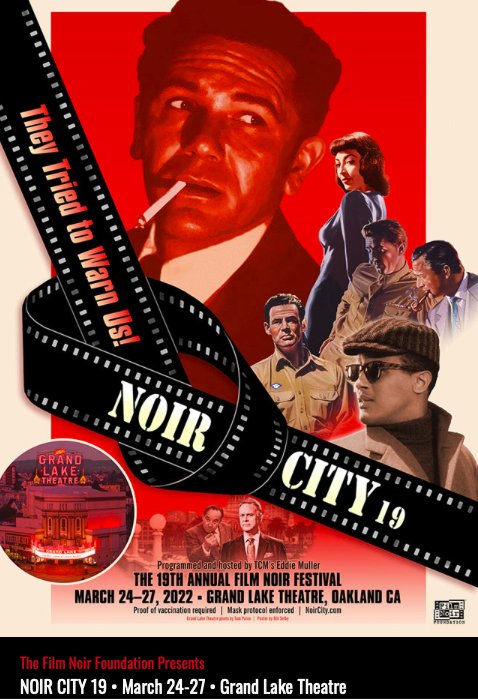
More than a tad bummed out over not being able to attend the 2022 Noir City festival, opening tonight at Oakland's Grand Theatre, we'll cheer ourselves up by nostalgically revisiting the memories of Noir City festivals gone by. . .
Particularly like the tres cool trailers a.k.a. overtures created by filmmaker Serena Bramble for the Noir City Film Festivals.
The Big Knockover: Noir City 15 Overture on Vimeo.
Serena Bramble's cinematic overture for the 14th Noir City Film Festival takes the cake for the sheer number of Hollywood stars - Bogey! Crawford! Garfield! Eddie G! - represented in a brief running time.
The epic Noir City film festival, lost to coronavirus lockdown in 2021, was slated to a new venue, Oakland's Grand Lake Theatre earlier this year, on January 29. Then along came, sadly, not Betty or Jones, but That Darn Omicron. Happily for fans of hard-boiled thrillers and cinema chiaroscuro, Noir City 19 has been rescheduled and will begin next Thursday.
To quote the official press release: 2022's edition, subtitled "They Tried to Warn Us!", showcases 12 movies from mid-20th century Hollywood sure to resonate with contemporary viewers. Included are shockingly prescient films focusing on megalomaniacal politicians, corrupt businessmen, neo-Nazis, racism, anti-Semitism, sexual predators, serial killers, police brutality — even a viral epidemic!
This NOIR CITY program could not be more timely or topical.
As far as the 2020's go, that description sounds about right - and Way Too Damn Lazy To Write A Blog would add "grifters," "grafters," "poseurs," "rat bastards", "sleazy oligarchs," "filthy rich dirtbags" and "craven cowards."
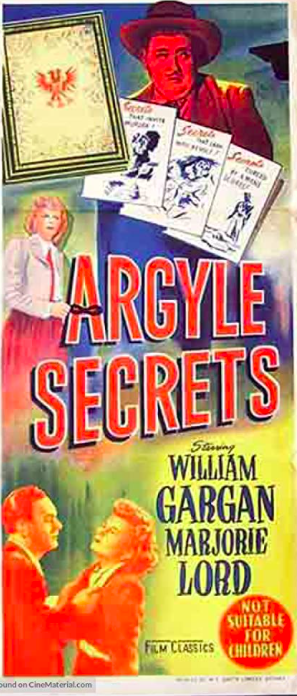
The press release adds:NOIR CITY 19: The Bay Area Film Noir Festival, will open with a double bill. First up, All the King's Men (1949), the noir-stained 1950 Best Picture Oscar winner, starring Broderick Crawford as Willie Stark, an ambitious Southern politician who doesn't let ethics interfere with his meteoric political rise. Crawford won a Best Actor Oscar for his performance.
It's paired with the world premiere of the FNF's latest 35mm restoration — The Argyle Secrets, a 1948 B-picture directed by Cy Endfield, returned to circulation this year through the partnership of the Film Noir Foundation and UCLA Film & Television Archive. The film's mystery centers around "The Argyle Album" containing the names of U.S. politicians and industrialists who abetted the Nazis in World War II.
Weeknight shows will be presented as double bills, with one $15 admission price for two movies. Saturday and Sunday shows will have separate admissions ($12.50) for each screening. All-Access Passports, granting admission to all 12 films, are available for $100, a $30 savings over the purchase price of individual tickets. FNF proceeds from the NOIR CITY festival benefit the foundation's efforts to rescue and restore noir films in danger of being permanently lost or damaged.
The full schedule, Passports (all-access passes), individual tickets, and program notes are available at NoirCity.com.
Sadly for the tough talkin' hard-boiled noirista-filled gang at Way Too Damn Lazy To Write A Blog, we will not be able to attend the 2022 festival. Sincerely hope we will be back watching classic noir in big screen glory in 2023. . . We shall miss all our friends who we enjoyed hanging out with at past Noir City events at San Francisco's Castro Theatre.
"Buster Keaton doing his own films was a master. Buster Keaton working for other people was a travesty.” YouTube poster, commenting on GENERAL NUISANCE (1941).
"Buster Keaton plays everything well, but there's absolutely nothing that feels specific to Buster Keaton in the material." IMDB commenter hte-trasme, commenting on THE SPOOK SPEAKS.
First and foremost, we tip our well-worn porkpie hat to Lea Stans of Silent-ology for hosting the annual Buster Keaton Blogathon and encouraging the following contribution from the diehard and dyed-in-the-wool Damfinos at Way Too Damn Lazy To Write A Blog.
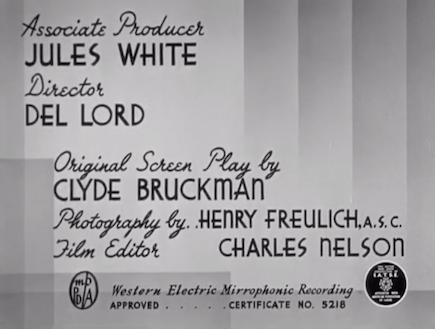
Today's topic is one of the low points of Keaton's career - arguably THE lowest point - the two years Buster spent starring in comedy short subjects created by Jules White and Del Lord at Columbia.
Just in case one is an enthusiastic fan of Buster and the studio's house-style gurus, The Three Stooges, the ten Columbia Keaton shorts are available on a 2-DVD set under the title Buster Keaton Collection. There are commentary tracks by comedy film historians throughout, if one can’t stop thinking of the 1920's masterpieces Cops, Sherlock Jr., The General, Our Hospitality, The Navigator and Steamboat Bill, Jr. and finds the misuse and misunderstanding of Buster in these films unbearable.
Classic movie buffs know the story: Buster makes magic, the most astonishing and original of all comedy films, as an independent producer, signs with MGM, who, making such Thanksgiving turkeys as Free & Easy and What? No Beer, ruin him as surely they subsequently made the worst movies of The Marx Brothers, Laurel & Hardy, Abbott & Costello and Our Gang.
Thus, Buster Keaton transitioned from MGM feature film star to the ignominious world of comedy shorts, first with Educational Pictures. The 2-reelers were made quickly and inexpensively, shot in three or four days.
As far as the Columbia Shorts Department goes, its product to this day remains lowbrow, and yet, it is difficult for this classic movie fan to dislike a production company that makes films titled “You Were Never Uglier” and “Three Dumb Clucks.”
The stars of the Columbia Shorts Department, unquestionably, were The Three Stooges, creating cartoony slapstick mayhem in some of their funniest films at the same time Buster Keaton was at Columbia. The formula works like a charm for them, at least until the serious health problems that led to Curly Howard's untimely passing in 1952 become undeniable onscreen in the mid-1940's.
Under producer Jules White, to some extent everybody on the lot made Three Stooges comedies, complete with the trademark sound effects and stock company, whether their individual style of and approach to comedy fit into the formula or not. So, with the Columbia Shorts Department, Buster Keaton and Harry Langdon, two idiosyncratic, clever and original comedy creators, essentially starred in knockabout slapstick. This was anathema to the approach they rode to 1920's feature film stardom. While this slapstick humor style frequently squelches the silent movie headliners, whose humor depended on nuance, Buster's astonishing ability to execute acrobatic falls and devise brilliant bits of comedy business often carries the day, both at Educational and Columbia.
Buster Keaton landed at Columbia Pictures in 1939 and, as he needed the steady work, signed for half the rate he had been paid to star in short subjects for Educational previously. In 1930, comedy short subjects still ruled the roost, with Hal Roach Studios specializing in them, but by 1939, Roach, Sennett and Educational were no longer producing short comedies and - with the exception of the 1-reel "Joe McDoakes" series made by Richard L. Bare for Warner Brothers - Columbia and RKO were the last studios to make them.
While "2-reelers" in particular were considered the minor leagues of movies, Buster took the job.
Columbia became the destination for former silent comedy performers, writers, cinematographers, producers and directors looking for work. At one point Del Lord, architect of insane car chases and Billy Bevan comedies at Mack Sennett's studio, Charley Chase from Hal Roach Studios, Harold Lloyd collaborator Felix Adler and Jules White's brother Jack (a.k.a. "Preston Black"), producer/director of funmakers from Lloyd Hamilton to Louise Fazenda at Educational Pictures, were all making 2-reelers for Columbia.
As noted, Keaton’s fellow silent feature star Harry Langdon was there at the Columbia Short Subjects on and off, as was uncrowned king of comedy short subjects Charley Chase. Of the three, Chase fared best by far and would appear to have maintained at least some creative control over his starring series and held on to a fair amount of his established onscreen persona, while also directing other comedians on the lot. He died in 1940 and it is likely that had Chase lived longer, his films would have increasingly veered into heavy-handed slapstick.
What suggestion do we have for the avid fan of Buster Keaton silents watching the 1939-1941 Columbia shorts for the first time? After all, Buster Keaton not only starred in The Goat but WAS the GOAT, a.k.a. Greatest Of All Time.
On one hand, DON'T WATCH THEM would very likely be the advice for Damfinos and silent movie mavens. Some of the Columbia shorts are not bad at all, even quite funny and enjoyable, but others are such unmitigated stinkers that, given the choice between watching one and shoving a dipstick from a 1976 Buick LeSabre as far up your nostril as humanly possible, the latter option would be best for Buster fans.
On the other hand, for classic comedy buffs who laugh out loud and invariably end up ROFL at Chaplin's Keystones, Larry Semon’s Vitagraph 1-reelers, Mack Sennett car chase epics (SUPER-DUPER DYNE LIZZIES), early Harold Lloyd comedies transitioning from dorky "Lonesome Luke" to his "glasses character, The Three Stooges' YOU NAZTY SPY, Laurel & Hardy in HELPMATES and both Buster silent era masterpieces as COPS and ONE WEEK, plus his work 30+ years later in television and even in AIP features, it might well be possible, with some trepidation, to watch Keaton's Columbia short subjects. Make no mistake about it, these "Buster the Stooge" Columbias suffer by direct comparison to Keaton's silents but certainly hold their own in the late 1930's and early 1940's 2-reeler universes of the Columbia Shorts Department and RKO's comedy shorts directed by Hal Yates.
Short films, while considered the ragged stepchild of prestigious feature films, were popular with audiences, and Buster, like his mentor Roscoe Arbuckle, began his silver screen career starring in short subjects. Buster created quite a few of the funniest, most inventive short comedies ever produced, the gold standard once he took over Roscoe Arbuckle's studio when the big fella graduated from 2-reelers to starring in feature films for Paramount. These Buster Keaton Comedies from from 1920-1923 are in the same category among silent era comedy triumphs as the Chaplin Mutuals, the last Harold Lloyd "glasses character" short subjects and, also produced by Hal Roach Studios, the films Leo McCarey directed for Laurel & Hardy and Charley Chase in 1924-1928.
Since the Columbia series is the first since the 1917-1920 Comique Productions films in which he co-starred with Roscoe Arbuckle and Al St. John to focus almost entirely on knockabout slapstick, another way to regard them is to imagine that the only existing silents featuring Buster Keaton were the Arbuckle Comique series - and that everything else went the way of the Fox and Universal comedies that burned up in the notorious 1937 vault fire in Little Ferry, New Jersey. Buster's solo films, from One Week through Spite Marriage, are not necessarily slapstick-oriented, although there is much physical comedy, as well as sight gags that inspired everybody from Mel Brooks to Chuck Jones.
The biggest problem with the Buster Keaton Columbia 2-reelers is something insidious that creeps into his films beginning with The Cameraman and extends through the MGM features and Educational Pictures short subjects: presenting Buster as a sad sack, a pathetic individual and a blithering idiot. Who was the genius who thought this somehow made Keaton funnier? It doesn't, and the Columbias are particularly egregious at presenting Buster as a dolt. This idea reflects a fundamental misunderstanding of his comedy and couldn't have come from Buster; given the onscreen results, from big-budget MGM features to threadbare Educational and Columbia short subjects, this remains absolutely incomprehensible. Yet, Buster playing an idiot is what is seen and repeated through the ten Columbia shorts. . . repeated over and over and over.
In Keaton's best films, the more competent, resourceful, clever and unconventional thinking the unassuming pork pie hat fellow is, the funnier he is - he's a smart guy who's just ever so slightly absent-minded, not an amalgamated moron in the Moe, Larry and Curly mode - but such films as The General were considered ancient history by 1940.
Another big problem and elephant in the room with this series is a by-product of the Jules White signature slapstick and related to the change in Buster's characterization that begins in The Cameraman: how often Buster is mistreated. He's pushed around and bullied to a degree not even seen in the misbegotten MGM features and Educational shorts, which denigrate Buster plenty. This never ends up being in the service of comedy. Buster The Stooge gets Buster gets bashed throughout the ten short subjects repeatedly and frequently for no reason; Keaton is constantly getting smashed in the face throughout the Columbia series and the point comes quickly where it's not funny. The viewer ends up feeling sorry for Buster. Unfortunately, "Moe Howard Theory", a specific sequence within The Three Stooges formula that gets laughs - Moe acting like a complete jerk, then getting hit hard with a two-by-four or large metal object - is nowhere to be found in the Keaton Columbias, even with supporting players Vernon Dent and Bud Jamison on hand to play the "Moe" part.
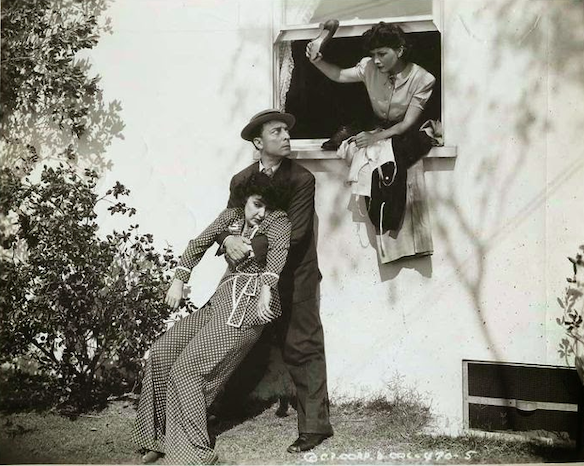
The third big problem with Buster’s Columbia series is Elsie Ames, an enthusiastic, energetic and unrelentingly in-your-face performer who could execute vigorous slapstick a la Joan Davis and Lucille Ball, but also possessed a pronounced penchant for overacting (note: Trav SD, author of Chain Of Fools, wrote a post about the slapstick comedienne on his Travalanche website, which also covered Jules White at length). Jules paired Buster with Elsie Ames - and the teaming doesn't work any better than teaming Keaton with Jimmy Durante in the MGM features.
Among a slew of brassy comediennes (Martha Raye, Mabel Todd, Judy Canova, Betty Hutton and rubber-faced Cass Daley), who came to prominence at that time, Elsie Ames made her show business name as part of the comedy dance team of Ames & Arno, seen here doing their pratfalling act in the 1937 Bing Crosby vehicle Double Or Nothing. It is possible to understand why Jules White and the Columbia Shorts Department signed her, as Ames is quite an accomplished acrobat and possesses a goofy personality.
One would venture to guess that Jules White envisioned Elsie as a Curly Howard-style slapstick comedy star who would headline her own series. Comparisons to Curly Howard prove difficult, as the NYUK NYUK NYUK WOOWOOWOO king's onscreen persona exudes a certain peculiar charm and highly unique timing that was, just about always, extremely funny. His characterization is weirdly likable and gets laughs. Oddly, Elsie Ames never appeared in the one Columbia Shorts Department series where she might have been a good fit - as a supporting player with The Three Stooges. Of course, if Elsie tried to upstage them even once. . .
Although Elsie Ames is, as noted, a gifted acrobat and a physical comedienne willing to take thunderous pratfalls that would give Roscoe Arbuckle and Al St. John pause, she tends to run roughshod over her co-stars at Columbia, not just Buster but Harry Langdon and El Brendel as well. It's comparable to a heavy metal guitarist whose only technique is to shred, shred, shred and then shred some more at high volume and ridiculous speeds but entirely without nuance or variation in dynamics. The concept of "less is more," at least at this stage of her show business career, is entirely lost upon Elsie.
When Keaton imbues the Three Stooges style slapstick with his more low-key and thoughtful personality, does it work? The writer feels that understatement surrounded by bombast can succeed, if it is allowed to. Is The Taming Of The Snood, a knockabout opus loaded with pure physical comedy and astonishing falls by both Keaton and Ames, overbearing or funny? Find it, like other Keaton Columbias, to be both - and love the opening scene with Buster modeling hats for Dorothy Appleby - but you be the judge. As is the case with slapstick gags in Laurel & Hardy and Three Stooges comedies, I find myself LOL at the extremity of it all. Again, with the Columbia series, draw the direct line to Arbuckle's Comiques, not Keaton's 1920's masterpieces, as Buster's pal Roscoe would have fit right into the Columbia Shorts Department and perhaps brought just a touch of that "slapstick ballet" quality from his Comiques and Keystones to the proceedings.
To cut Elsie just a tiny bit of a break, here is one sequence from General Nuisance in which she does include her strong suit, dancing. This sequence is still dominated by shameless mugging and knockabout, but the hoofing is enjoyable and there's something to like in this song-and-dance bit; as much as Elsie and Buster slap each other around, the musical number indicates a possible direction other than 100% knockabout this series could have taken. Buster sings and dances, and, as always, is funny and charming. If Elsie could have just done a moment here or a moment there of nothing, of repose, for a breath. Whether this was her sensibility or Jules' direction, we don't know. That said, we know Buster was too much of a gentleman to overrule the director or tell her to shut up.
Interestingly, Elsie Ames redeemed herself for the enthusiastic and well-intended but overbearing performances in Columbia 2-reelers with her last appearances in movies 30 years later, in the John Casavettes films Minnie and Moskowitz and A Woman Under The Influence. Casavettes was an original, innovative and first-rate feature film director and turned out to be the one to successfully bring out the acting mojo in Elsie Ames. She's good in both movies and, as a senior citizen, totally unrecognizable from the knockabout clown from the Columbia 2-reelers.
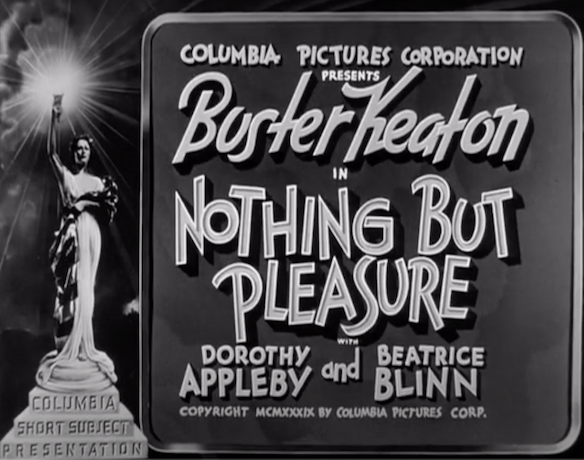
Of the ten Columbia shorts, we at Way Too Damn Lazy To Write A Blog have a favorite. That would be Nothing but Pleasure, in which a bus trip to Detroit devised to save money on shipping the newly bought auto is an unmitigated disaster. This is a Buster piece in that he brings back the "getting a stone drunk woman to bed" bit from Spite Marriage (and several other films), as well as a Clyde Bruckman piece which includes a gag involving parking a car in a tight space which was previously seen in Lloyd Hamilton's TOO MANY HIGHBALLS (1933) and, with improvements, the hilarious W.C. Fields feature THE MAN ON THE FLYING TRAPEZE (1935). Redolent with Clyde Bruckman's dark sensibility, Nothing But Pleasure is very much a Lloyd Hamilton-like piece in its fatalistic "everything happens to me" scenario.
Although Buster does not portray the sharpest tool in the shed, or even the resourceful fellow we see in his silent features, thankfully, he does not play a complete idiot, just a guy who, like Lloyd "Ham" Hamilton and Albert King, is born under a bad sign. Unlike Lloyd Hamilton and W.C. Fields, Buster's character is chock full of cheerful earnestness - and the contrast with the viewpoints of his long-suffering wife (played by Dorothy Appleby) and Bud Jamison as a puzzled police officer, makes this a very good, very funny comedy short.
Also like So You Won't Squawk, with a gangster and chase-filled plot reminiscent of the Gus Schilling - Richard Lane comedies produced by the Columbia Shorts Department a few years later. Buster is mistaken for a gangland kingpin and it's off to the races. Keaton takes fall after fall after all in this and adapts surprisingly well to the fast-fast-fast and then faster Jules White ethos throughout.
One wonders, watching the Columbia Keatons and seeing them wrecked over and over by loud, hammy, irritating performances, is whether anyone thought of casting Buster’s wife Eleanor, who he married in 1940, even briefly. She was not under contract to the Columbia Shorts Department and perhaps, after hearing how very unhappy her husband was there, would have opted not to appear in these slapstick-heavy films had she been offered the opportunity to do so. In the 1950’s, Eleanor would work onstage with Buster at the Cirque Medrano with great success.
All ten Keaton Columbias are, at least at this moment, up on YouTube. Proceed at your own risk.
In his 2010 book The Fall of Buster Keaton: His Films for MGM, Educational Pictures, and Columbia. Author James L. Neibaur delves into Buster’s post-Steamboat Bill. Jr. films at length. The encyclopedia on the subject, Columbia Comedy Shorts: Two-Reel Hollywood Film Comedies, 1933-1958 by Ted Okuda and Edward Watz, is out of print in hardback, but available in paperback and on Kindle - and well worth checking out, as the authors painstakingly review hundreds of Shorts Department films. Leonard Maltin discusses Buster's comedy in The Great Movie Shorts and The Great Movie Comedians and offers his insights.
All we can say in closing is, "thanks, Buster" and "thanks, Eleanor" - and note how many genuinely funny moments turn up between the knockabout in the Columbia series. No Keaton film, no matter how threadbare, is a total loss because he's in it, making great comedy regardless of the circumstances.