Finishing this extended plunge into the slapstick of The Shorts Department, the spotlight shines on the guy who cranked out numerous Three Stooges shorts in the latter 1940's and early 1950's, longtime Columbia Studio soundman Edward Bernds.
Chicago-born Edward Bernds was a pioneering soundman who, after working with Frank Capra and Howard Hawks, would become a prolific director of silver screen comedies, television series and psychotronic B-films. He lived to be 95 and thus gave numerous interviews.
Mr. Bernds had the unenviable task of directing Three Stooges comedies when Curly Howard's health was rapidly declining in the mid-1940's.
He did a remarkable job working around the NYUK NYUK NYUK king's health issues and getting Curly's last great comedy performances on film.
He also did a stellar job handling the comedy team's transition from Curly to Shemp.
Greg Hilbrich's historical overview of The Shorts Department adds: "In 1944, Edward Bernds, a sound mixer at Columbia since the shorts department's beginnings, began writing scripts for the shorts, only later to find himself in the director's chair. Bernds is responsible for some of the finest two-reel comedies Columbia made."
His Columbia comedy short subjects featured unusual choices of headliners. For example, Billie Burke, ubiquitous character actress known for, among numerous parts, Glinda The Good Witch from The Wizard Of Oz, starred in Columbia 2-reelers. While Billie remains the least likely to headline a Three Stooges style knockabout comedy, it happened!
Ex-pugilists Max Baer and "Slapsie Maxie" Rosenbloom swapped taking punches in the ring for Moe Howard style mega-slaps in the movies!
Edward Bernds directed several short subjects starring character actor and cartoon voice artist Sterling Holloway.
The slapstick team of Gus Schilling & Richard Lane made a series of very funny and very over-the-top comedy shorts in the Three Stooges knockabout school.
Future "3rd Stooges" Joe De Rita and Joe Besser also starred in 2-reelers directed by Edward Bernds at Columbia.
After leaving the Columbia Shorts Department in 1952, Edward Bernds directed films for Allied Artists, including The Bowery Boys Meet The Monsters, starring Huntz Hall, Leo Gorcey and Guy In A Gorilla Suit.
Edward Bernds' extended career in movies and TV included psychotronic B-films.
Including the classic SPACE X-7!
Hard not to love a guy who directed Queen Of Outer Space!
Last week's post on rubber-legged slapstick master Leon Errol and silver screen humor essential Mel Brooks, as well as the previous one on The Three Stooges, has profoundly immersed this blog in the pratfall-packed world of physical comedy.
We've been heavily into Slapstickland, both silents and talkies, for the past three months. And many moons ago, back in 2013 (which now feels like 1913), wrote an extended series of Way Too Damn Lazy To Write a Blog posts paying tribute to the Columbia Shorts Department and Jules White.
Lee Weinstein's 2023 article The Rivals Of The Three Stooges adeptly covers the comedy headliners from Columbia 2-reelers at length and gets us thinking of the guy who spent 20 years with The Shorts Department before going on to a successful career in television, former silent slapstick perennial and Mack Sennett stock company player Andy Clyde.
In I'M A FATHER, Andy plays the "cranky old stick in the mud" to perfection.
In such Columbia 2-reelers as OLD SAWBONES, a collaboration between prolific silent comedy creators Del Lord and Jack "Preston Black" White, Andy presents a down-home variant on the physical comedy formula of Moe, Larry and Curly.
Now it's on to character actor supreme, the guy who coached none other than Kate Hepburn in comedy chops during the making of Bringing Up Baby, the great Broadway and movie comedian Walter Catlett.
Here's Walter in Get Along Little Hubby (1934). (Note: the following transfer is very out of sync). He co-stars with Vivien Oakland, very much a key player in the first year of The Shorts Department (and a take-no-prisoners character actress here), as well as ubiquitous slapstick comedy stalwart, future Columbia 2-reelers headliner and Three Stooges co-star Monte Collins.
In case you're wondering why Walter Catlett seems more than vaguely familiar. . .
Indeed, that is a wonderful performance in Pinocchio as J. Worthington Foulfellow A.K.A."Honest John."
In between his numerous character roles in feature films, Catlett turns up periodically in Columbia shorts through the early 1940's; he even co-stars with the popular Guy In A Gorilla Suit, who torments Walt and Dudley Dickerson (the talented African-American comedian invariably cast in grotesque stereotyped parts) in YOU'RE NEXT.
BLONDES AND BLUNDERS has a pronounced Moe-Larry-Curley style knockabout approach throughout, in no small part due to the presence of irreplaceable Three Stooges supporting comics Bud Jamison and Vernon Dent.
Walter Catlett had prominent roles in comedy and musical short subjects long before working for Columbia. Here he is, teamed with none other than gravel-voiced Eugene Pallette.
One of the most memorable Walter Catlett performances is in Mark Sandrich's 1933 RKO opus SO THIS IS HARRIS (1933).
Have devoted many blog posts to the unorthodox and original comedian Harry Langdon over the years.
Like Buster Keaton and Charley Chase, Harry was among the former silent movie headliners making 2-reelers at Columbia. Langdon was one of two Harrys - the second was Harry von Zell in 1946-1950 - to headline short subjects for The Shorts Department.
The Columbia Langdon comedies remain a mixed bag; some - SHIVERS, HIS MARRIAGE MIX-UP (the 1935 predecessor to Saturday Night Live star Mike Myers' 1993 feature film So I Married An Axe Murderer) - are still lost films.
Langdon, an unique and idiosyncratic performer, was especially ill-suited to Jules White's tendency to make Three Stooges comedies with all Shorts Department headliners.
At that point Harry, who was pushing 40 when he debuted in movies, was in his fifties and no longer able to do strenuous physical slapstick. Nonetheless, the comedy-crazed gang here find Langdon's appearances in features and short subjects, more often than not, to be quite funny; check him out in Lewis Milestone's Hallelujah, I'm A Bum (1933).
The following, directed by frequent Langdon collaborator Arthur Ripley and written by the inventive and prolific Harry McCoy, is a sendup of Warner Brothers' Warren William vehicle and courtroom drama The Mouthpiece (1932). Harry sports a mustache!
Harry works quite well with the marvelously and unabashedly over-the-top Hal Roach Studios comedian and cartoon voice artist Billy Gilbert in this 1935 2-reeler. Langdon's the straight man here! Billy reprises the raving loony he portrayed with relish in the Three Stooges opus Men In Black.
For more on this great movie comedian, check out Chicago historian Nicole Arciola's terrific Harry Langdon Archive YouTube channel, a classic comedy treasure trove.
Today we tip a battered top hat worn by a boisterous and three sheets to the wind Ted Healy to the great Moe Howard, ace of slapstick!
After a decade performing in vaudeville and stage and films as part of the popular knockabout act Ted Healy & His Stooges, Moe succeeded Ted as "the head stooge" when the team and Healy parted ways and The Three Stooges began starring in short subjects for Columbia Pictures in 1934.
Still hear the comedy team's various theme songs whenever I see the "A Screen Gems Film Presentation: Television Subsidiary" logo.
And now for some choice slapstick snippets. . .
As we continue having a rough go through 2026, a bit of "laughter is the best medicine" from Moe Howard, born on this day in 1897, and the Three Stooges, starting with the following excellent documentary by his son Paul, proves a most worthy Rx.
Love this interview with Moe.
Moe's daughter, Joan Howard Maurer, appeared on Late Night with David Letterman in February 1983. The early 1980's NBC incarnation of Letterman's freewheeling program frequently booked guests representing the golden age of classic comedy from movies, TV and radio.
Now it's time, on Moe's natal anniversary, for some big time Stoogery! This comedy fan is especially fond of the first 2-reelers they made for Columbia in 1934-1935.
The blonde in the following opus looks vaguely familiar. . .
Today we pay tribute to comedy icon and key Stooge Jerome Lester Horwitz, a.k.a. Curly Howard, born on October 22, 1903.
We'll kick this off with a certain scene that always gets me ROFL - and the Jump 'n the Saddle Band's 1983 hit record "The Curly Shuffle."
Yes, we indeed have binge-watched Three Stooges comedies on YouTube, Daily Motion and DVD on many occasions.
One of the numerous Daily Motion channels, "Film Gorillaz," among dozens of 1930's movies, posted the following compilation of Moe, Larry & Curly classics. It includes such famous Three Stooges extravaganzas as A-Plumbing We Will Go and Micro-Phonies, but also several of the earliest Columbia 2-reelers, made in 1934.
These first season entries - Woman Haters, Punch Drunks, Men In Black and Three Little Pigskins - feature some of the funniest, wildest, most energetic and incendiary performances of the then-youthful Curly. Co-stars include comedy royalty from Lucille Ball to Dorothy Granger to Marjorie White to Arthur Housman and, as always, the ubiquitous Bud Jamison.
Noting how Curly successfully brought 1920's style slapstick into talkies, we single out Ants In The Pantry, one of several hilarious Stooge vehicles directed in 1936-1937 by Jack "Preston Black" White, the architect of excellent 1920's silent 2-reelers starring sad sack comic Lloyd Hamilton at Educational Pictures (a.k.a. "The Spice Of The Program").
Of the Three Stooges series' many dessert-throwing epics, especially like the cream puff war that closes Slippery Silks (1936), also directed by "Preston Black."
And, speaking of Del Lord of Mack Sennett Productions and Columbia Shorts Department fame, here's Dizzy Doctors, one of the funniest of Del's numerous Stooge comedies.
Jules White's greatest achievement of many in Stoogedom over three decades?
Arguably that would be the comedy team enthusiastically delivering an eye-poke to Adolph Hitler and his henchman in You Nazty Spy! and I'll Never Heil Again. Still love the Howard boys' Shicklegruber sendups!
Wonder if the Howard brothers knew Charlie Chaplin, who was working on The Great Dictator when the Stooges made You Nazty Spy!
Dutiful But Dumb includes a personal favorite Curly sequence, the battle with the oyster soup, as well as a cameo by the very funny Keystone and Charlie Chaplin comedies supporting player Chester Conklin. This is fitting, as a previous appearance of "the oyster stew bit" was in a Mack Sennett silent classic, Ice Cold Cocos, starring Billy Bevan and directed by Stooge auteur Del Lord.
In this writer's opinion, Curly and the Stooges were at their very best in 1934-1941. After that, Curly's health setbacks began to be obvious onscreen. Unfortunately, Harry Cohn said no to putting the series on hiatus or giving Curly time off, as Three Stooges comedies were by far the most popular productions of the Columbia Shorts Department.
After a massive stroke felled Curly in May 1946, The Three Stooges regrouped and subsequently made a comeback with Shemp Howard back in the team as the third Stooge, former Columbia Pictures soundman Edward Bernds directing and Vernon Dent, Christine McIntyre, Emil Sitka and perennial bad guy Kenneth McDonald contributing their customary stellar supporting work.
Way Too Damn Lazy To Write A Blog toasts Curly Howard, The Three Stooges and the both invaluable and funny supporting players Bud Jamison, Vernon Dent and Symona Boniface.
In closing, we raise our tumblers not just to Curly, Moe, Larry and Shemp, but the many other comedy greats who ended up, either briefly or for a lengthy stretch, starring in Columbia 2-reelers.
These include prolific silent movie comedians Harry Langdon, Buster Keaton, Charley Chase and Andy Clyde.
These outstanding comedians repeatedly made audiences laugh out loud way back when - and still do in 2022!
"Buster Keaton doing his own films was a master. Buster Keaton working for other people was a travesty.” YouTube poster, commenting on GENERAL NUISANCE (1941).
"Buster Keaton plays everything well, but there's absolutely nothing that feels specific to Buster Keaton in the material." IMDB commenter hte-trasme, commenting on THE SPOOK SPEAKS.
First and foremost, we tip our well-worn porkpie hat to Lea Stans of Silent-ology for hosting the annual Buster Keaton Blogathon and encouraging the following contribution from the diehard and dyed-in-the-wool Damfinos at Way Too Damn Lazy To Write A Blog.
Today's topic is one of the low points of Keaton's career - arguably THE lowest point - the two years Buster spent starring in comedy short subjects created by Jules White and Del Lord at Columbia.
Just in case one is an enthusiastic fan of Buster and the studio's house-style gurus, The Three Stooges, the ten Columbia Keaton shorts are available on a 2-DVD set under the title Buster Keaton Collection. There are commentary tracks by comedy film historians throughout, if one can’t stop thinking of the 1920's masterpieces Cops, Sherlock Jr., The General, Our Hospitality, The Navigator and Steamboat Bill, Jr. and finds the misuse and misunderstanding of Buster in these films unbearable.
Classic movie buffs know the story: Buster makes magic, the most astonishing and original of all comedy films, as an independent producer, signs with MGM, who, making such Thanksgiving turkeys as Free & Easy and What? No Beer, ruin him as surely they subsequently made the worst movies of The Marx Brothers, Laurel & Hardy, Abbott & Costello and Our Gang.
Thus, Buster Keaton transitioned from MGM feature film star to the ignominious world of comedy shorts, first with Educational Pictures. The 2-reelers were made quickly and inexpensively, shot in three or four days.
As far as the Columbia Shorts Department goes, its product to this day remains lowbrow, and yet, it is difficult for this classic movie fan to dislike a production company that makes films titled “You Were Never Uglier” and “Three Dumb Clucks.”
The stars of the Columbia Shorts Department, unquestionably, were The Three Stooges, creating cartoony slapstick mayhem in some of their funniest films at the same time Buster Keaton was at Columbia. The formula works like a charm for them, at least until the serious health problems that led to Curly Howard's untimely passing in 1952 become undeniable onscreen in the mid-1940's.
Under producer Jules White, to some extent everybody on the lot made Three Stooges comedies, complete with the trademark sound effects and stock company, whether their individual style of and approach to comedy fit into the formula or not. So, with the Columbia Shorts Department, Buster Keaton and Harry Langdon, two idiosyncratic, clever and original comedy creators, essentially starred in knockabout slapstick. This was anathema to the approach they rode to 1920's feature film stardom. While this slapstick humor style frequently squelches the silent movie headliners, whose humor depended on nuance, Buster's astonishing ability to execute acrobatic falls and devise brilliant bits of comedy business often carries the day, both at Educational and Columbia.
Buster Keaton landed at Columbia Pictures in 1939 and, as he needed the steady work, signed for half the rate he had been paid to star in short subjects for Educational previously. In 1930, comedy short subjects still ruled the roost, with Hal Roach Studios specializing in them, but by 1939, Roach, Sennett and Educational were no longer producing short comedies and - with the exception of the 1-reel "Joe McDoakes" series made by Richard L. Bare for Warner Brothers - Columbia and RKO were the last studios to make them.
While "2-reelers" in particular were considered the minor leagues of movies, Buster took the job.
Columbia became the destination for former silent comedy performers, writers, cinematographers, producers and directors looking for work. At one point Del Lord, architect of insane car chases and Billy Bevan comedies at Mack Sennett's studio, Charley Chase from Hal Roach Studios, Harold Lloyd collaborator Felix Adler and Jules White's brother Jack (a.k.a. "Preston Black"), producer/director of funmakers from Lloyd Hamilton to Louise Fazenda at Educational Pictures, were all making 2-reelers for Columbia.
As noted, Keaton’s fellow silent feature star Harry Langdon was there at the Columbia Short Subjects on and off, as was uncrowned king of comedy short subjects Charley Chase. Of the three, Chase fared best by far and would appear to have maintained at least some creative control over his starring series and held on to a fair amount of his established onscreen persona, while also directing other comedians on the lot. He died in 1940 and it is likely that had Chase lived longer, his films would have increasingly veered into heavy-handed slapstick.
What suggestion do we have for the avid fan of Buster Keaton silents watching the 1939-1941 Columbia shorts for the first time? After all, Buster Keaton not only starred in The Goat but WAS the GOAT, a.k.a. Greatest Of All Time.
On one hand, DON'T WATCH THEM would very likely be the advice for Damfinos and silent movie mavens. Some of the Columbia shorts are not bad at all, even quite funny and enjoyable, but others are such unmitigated stinkers that, given the choice between watching one and shoving a dipstick from a 1976 Buick LeSabre as far up your nostril as humanly possible, the latter option would be best for Buster fans.
On the other hand, for classic comedy buffs who laugh out loud and invariably end up ROFL at Chaplin's Keystones, Larry Semon’s Vitagraph 1-reelers, Mack Sennett car chase epics (SUPER-DUPER DYNE LIZZIES), early Harold Lloyd comedies transitioning from dorky "Lonesome Luke" to his "glasses character, The Three Stooges' YOU NAZTY SPY, Laurel & Hardy in HELPMATES and both Buster silent era masterpieces as COPS and ONE WEEK, plus his work 30+ years later in television and even in AIP features, it might well be possible, with some trepidation, to watch Keaton's Columbia short subjects. Make no mistake about it, these "Buster the Stooge" Columbias suffer by direct comparison to Keaton's silents but certainly hold their own in the late 1930's and early 1940's 2-reeler universes of the Columbia Shorts Department and RKO's comedy shorts directed by Hal Yates.
Short films, while considered the ragged stepchild of prestigious feature films, were popular with audiences, and Buster, like his mentor Roscoe Arbuckle, began his silver screen career starring in short subjects. Buster created quite a few of the funniest, most inventive short comedies ever produced, the gold standard once he took over Roscoe Arbuckle's studio when the big fella graduated from 2-reelers to starring in feature films for Paramount. These Buster Keaton Comedies from from 1920-1923 are in the same category among silent era comedy triumphs as the Chaplin Mutuals, the last Harold Lloyd "glasses character" short subjects and, also produced by Hal Roach Studios, the films Leo McCarey directed for Laurel & Hardy and Charley Chase in 1924-1928.
Since the Columbia series is the first since the 1917-1920 Comique Productions films in which he co-starred with Roscoe Arbuckle and Al St. John to focus almost entirely on knockabout slapstick, another way to regard them is to imagine that the only existing silents featuring Buster Keaton were the Arbuckle Comique series - and that everything else went the way of the Fox and Universal comedies that burned up in the notorious 1937 vault fire in Little Ferry, New Jersey. Buster's solo films, from One Week through Spite Marriage, are not necessarily slapstick-oriented, although there is much physical comedy, as well as sight gags that inspired everybody from Mel Brooks to Chuck Jones.
The biggest problem with the Buster Keaton Columbia 2-reelers is something insidious that creeps into his films beginning with The Cameraman and extends through the MGM features and Educational Pictures short subjects: presenting Buster as a sad sack, a pathetic individual and a blithering idiot. Who was the genius who thought this somehow made Keaton funnier? It doesn't, and the Columbias are particularly egregious at presenting Buster as a dolt. This idea reflects a fundamental misunderstanding of his comedy and couldn't have come from Buster; given the onscreen results, from big-budget MGM features to threadbare Educational and Columbia short subjects, this remains absolutely incomprehensible. Yet, Buster playing an idiot is what is seen and repeated through the ten Columbia shorts. . . repeated over and over and over.
In Keaton's best films, the more competent, resourceful, clever and unconventional thinking the unassuming pork pie hat fellow is, the funnier he is - he's a smart guy who's just ever so slightly absent-minded, not an amalgamated moron in the Moe, Larry and Curly mode - but such films as The General were considered ancient history by 1940.
Another big problem and elephant in the room with this series is a by-product of the Jules White signature slapstick and related to the change in Buster's characterization that begins in The Cameraman: how often Buster is mistreated. He's pushed around and bullied to a degree not even seen in the misbegotten MGM features and Educational shorts, which denigrate Buster plenty. This never ends up being in the service of comedy. Buster The Stooge gets Buster gets bashed throughout the ten short subjects repeatedly and frequently for no reason; Keaton is constantly getting smashed in the face throughout the Columbia series and the point comes quickly where it's not funny. The viewer ends up feeling sorry for Buster. Unfortunately, "Moe Howard Theory", a specific sequence within The Three Stooges formula that gets laughs - Moe acting like a complete jerk, then getting hit hard with a two-by-four or large metal object - is nowhere to be found in the Keaton Columbias, even with supporting players Vernon Dent and Bud Jamison on hand to play the "Moe" part.
The third big problem with Buster’s Columbia series is Elsie Ames, an enthusiastic, energetic and unrelentingly in-your-face performer who could execute vigorous slapstick a la Joan Davis and Lucille Ball, but also possessed a pronounced penchant for overacting (note: Trav SD, author of Chain Of Fools, wrote a post about the slapstick comedienne on his Travalanche website, which also covered Jules White at length). Jules paired Buster with Elsie Ames - and the teaming doesn't work any better than teaming Keaton with Jimmy Durante in the MGM features.
Among a slew of brassy comediennes (Martha Raye, Mabel Todd, Judy Canova, Betty Hutton and rubber-faced Cass Daley), who came to prominence at that time, Elsie Ames made her show business name as part of the comedy dance team of Ames & Arno, seen here doing their pratfalling act in the 1937 Bing Crosby vehicle Double Or Nothing. It is possible to understand why Jules White and the Columbia Shorts Department signed her, as Ames is quite an accomplished acrobat and possesses a goofy personality.
One would venture to guess that Jules White envisioned Elsie as a Curly Howard-style slapstick comedy star who would headline her own series. Comparisons to Curly Howard prove difficult, as the NYUK NYUK NYUK WOOWOOWOO king's onscreen persona exudes a certain peculiar charm and highly unique timing that was, just about always, extremely funny. His characterization is weirdly likable and gets laughs. Oddly, Elsie Ames never appeared in the one Columbia Shorts Department series where she might have been a good fit - as a supporting player with The Three Stooges. Of course, if Elsie tried to upstage them even once. . .
Although Elsie Ames is, as noted, a gifted acrobat and a physical comedienne willing to take thunderous pratfalls that would give Roscoe Arbuckle and Al St. John pause, she tends to run roughshod over her co-stars at Columbia, not just Buster but Harry Langdon and El Brendel as well. It's comparable to a heavy metal guitarist whose only technique is to shred, shred, shred and then shred some more at high volume and ridiculous speeds but entirely without nuance or variation in dynamics. The concept of "less is more," at least at this stage of her show business career, is entirely lost upon Elsie.
When Keaton imbues the Three Stooges style slapstick with his more low-key and thoughtful personality, does it work? The writer feels that understatement surrounded by bombast can succeed, if it is allowed to. Is The Taming Of The Snood, a knockabout opus loaded with pure physical comedy and astonishing falls by both Keaton and Ames, overbearing or funny? Find it, like other Keaton Columbias, to be both - and love the opening scene with Buster modeling hats for Dorothy Appleby - but you be the judge. As is the case with slapstick gags in Laurel & Hardy and Three Stooges comedies, I find myself LOL at the extremity of it all. Again, with the Columbia series, draw the direct line to Arbuckle's Comiques, not Keaton's 1920's masterpieces, as Buster's pal Roscoe would have fit right into the Columbia Shorts Department and perhaps brought just a touch of that "slapstick ballet" quality from his Comiques and Keystones to the proceedings.
To cut Elsie just a tiny bit of a break, here is one sequence from General Nuisance in which she does include her strong suit, dancing. This sequence is still dominated by shameless mugging and knockabout, but the hoofing is enjoyable and there's something to like in this song-and-dance bit; as much as Elsie and Buster slap each other around, the musical number indicates a possible direction other than 100% knockabout this series could have taken. Buster sings and dances, and, as always, is funny and charming. If Elsie could have just done a moment here or a moment there of nothing, of repose, for a breath. Whether this was her sensibility or Jules' direction, we don't know. That said, we know Buster was too much of a gentleman to overrule the director or tell her to shut up.
Interestingly, Elsie Ames redeemed herself for the enthusiastic and well-intended but overbearing performances in Columbia 2-reelers with her last appearances in movies 30 years later, in the John Casavettes films Minnie and Moskowitz and A Woman Under The Influence. Casavettes was an original, innovative and first-rate feature film director and turned out to be the one to successfully bring out the acting mojo in Elsie Ames. She's good in both movies and, as a senior citizen, totally unrecognizable from the knockabout clown from the Columbia 2-reelers.
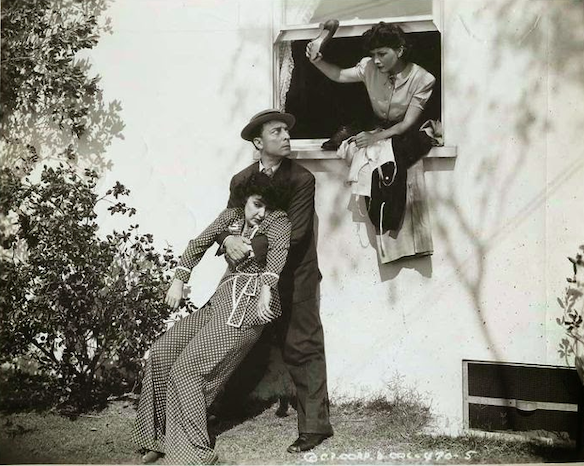
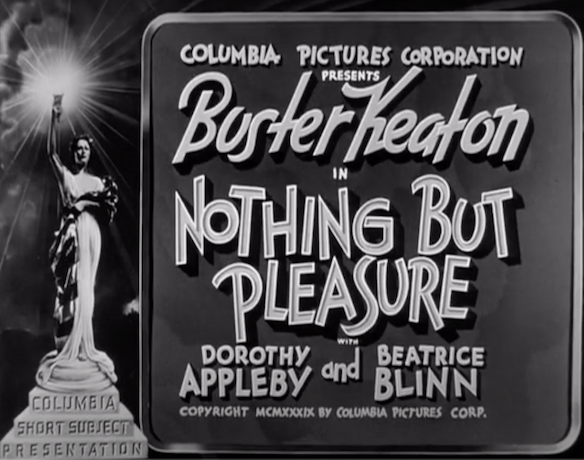
Of the ten Columbia shorts, we at Way Too Damn Lazy To Write A Blog have a favorite. That would be Nothing but Pleasure, in which a bus trip to Detroit devised to save money on shipping the newly bought auto is an unmitigated disaster. This is a Buster piece in that he brings back the "getting a stone drunk woman to bed" bit from Spite Marriage (and several other films), as well as a Clyde Bruckman piece which includes a gag involving parking a car in a tight space which was previously seen in Lloyd Hamilton's TOO MANY HIGHBALLS (1933) and, with improvements, the hilarious W.C. Fields feature THE MAN ON THE FLYING TRAPEZE (1935). Redolent with Clyde Bruckman's dark sensibility, Nothing But Pleasure is very much a Lloyd Hamilton-like piece in its fatalistic "everything happens to me" scenario.
Although Buster does not portray the sharpest tool in the shed, or even the resourceful fellow we see in his silent features, thankfully, he does not play a complete idiot, just a guy who, like Lloyd "Ham" Hamilton and Albert King, is born under a bad sign. Unlike Lloyd Hamilton and W.C. Fields, Buster's character is chock full of cheerful earnestness - and the contrast with the viewpoints of his long-suffering wife (played by Dorothy Appleby) and Bud Jamison as a puzzled police officer, makes this a very good, very funny comedy short.
Also like So You Won't Squawk, with a gangster and chase-filled plot reminiscent of the Gus Schilling - Richard Lane comedies produced by the Columbia Shorts Department a few years later. Buster is mistaken for a gangland kingpin and it's off to the races. Keaton takes fall after fall after all in this and adapts surprisingly well to the fast-fast-fast and then faster Jules White ethos throughout.
One wonders, watching the Columbia Keatons and seeing them wrecked over and over by loud, hammy, irritating performances, is whether anyone thought of casting Buster’s wife Eleanor, who he married in 1940, even briefly. She was not under contract to the Columbia Shorts Department and perhaps, after hearing how very unhappy her husband was there, would have opted not to appear in these slapstick-heavy films had she been offered the opportunity to do so. In the 1950’s, Eleanor would work onstage with Buster at the Cirque Medrano with great success.
All ten Keaton Columbias are, at least at this moment, up on YouTube. Proceed at your own risk.
In his 2010 book The Fall of Buster Keaton: His Films for MGM, Educational Pictures, and Columbia. Author James L. Neibaur delves into Buster’s post-Steamboat Bill. Jr. films at length. The encyclopedia on the subject, Columbia Comedy Shorts: Two-Reel Hollywood Film Comedies, 1933-1958 by Ted Okuda and Edward Watz, is out of print in hardback, but available in paperback and on Kindle - and well worth checking out, as the authors painstakingly review hundreds of Shorts Department films. Leonard Maltin discusses Buster's comedy in The Great Movie Shorts and The Great Movie Comedians and offers his insights.
All we can say in closing is, "thanks, Buster" and "thanks, Eleanor" - and note how many genuinely funny moments turn up between the knockabout in the Columbia series. No Keaton film, no matter how threadbare, is a total loss because he's in it, making great comedy regardless of the circumstances.
The Buster Keaton Blogathon, hosted by film historian, writer and silent movie expert Lea Stans of the outstanding Silentology webpage, is back with a brand new lineup of scholarly, informative posts on The Great Stone Face for 2022. As always, there will be plenty of interesting pieces by good writers.
The gang at Way Too Damn Lazy To Write A Blog are very pleased to be among the contributors to the 8th Buster Blogathon and shall be writing a post titled Mr. Keaton Goes To The Columbia Shorts Department about The Great Stone Face's ignominious (but better than one would expect) stretch starring in proto-Three Stooges 2-reelers for Jules White and Del Lord. Long ago and far away, we posted a six-part series delving into the history of the Columbia Shorts Department in this very space.
Keaton, then as in March 2022 the GOAT, starred in his own series for the Columbia Shorts Department, as did fellow silent comedy aces Charley Chase, Harry Langdon and Andy Clyde, the Mack Sennett studio's most ubiquitous stock company stalwart. All created bits and entire films at the Columbia Shorts Department featuring inspired comedy, alternating with ill-fated but sometimes surprisingly successful efforts within the slapstick formula that worked like a charm for Moe, Larry and Curly (note: Chase directed Three Stooges comedies, with felicitous results).
While Buster, not surprisingly, absolutely loathed the 2-reelers he starred in for both Columbia and Educational, dismissed them (accurately) as cheap shorts, IMHO, both these and the 1934-1937 Educational Pictures 2-reelers offer more unadulterated Buster than the MGM talkie features.
The Columbia shorts were Buster's least favorite films from his entire career - no shock here, considering that the same guy made The General, arguably still among the handful of greatest and most beautifully realized feature films ever produced.
Always happy to defend films nobody likes, Way Too Damn Lazy To Write A Blog will give the Jules White and Del Lord “Buster Goes Stooge” films, often featuring ace comedy supporting players Bud Jamison, Vernon Dent and Monty Collins, a little love. Whatever the scenario is, Buster makes the very best of it.
Here, proving behind an inkling of a shadow of a doubt that Mr. Blogmeister adores cheap comedy shorts, is the last in a series about the Columbia Shorts Department.
This was no small feat, as clips from even the most obscure Columbia 2-reelers - even unavailable titles which do not star once and future members of The Three Stooges and will never, ever get an official DVD release - have been getting yanked in quantity from YouTube (obviously, one of the 5 or 6 regular readers of this blog works for Sony Pictures).
The big game-changer for theatrical short subjects was the end of Block Booking, which guaranteed movie studios an audience for short subjects and was struck down by a 1948 Supreme Court ruling. With Block Booking in place, studios could say to theatre owners "if you want that Jean Arthur feature directed by Frank Capra, pallie, then you have to take these El Brendel-Tom Kennedy shorts and Columbia Color Rhapsodies and Fables cartoons, too - like it or not".
Television became the key outlet for live-action slapstick, showcasing comedy by Milton Berle, Sid Caesar, Imogene Coca and Lucille Ball, with Martin & Lewis, Abbott & Costello and Ernie Kovacs soon to follow. By the premiere of I Love Lucy, The Three Stooges, seeing the writing on the wall, had made many TV appearances.
The 1950's saw big changes at The Shorts Department. Hugh Herbert passed away in March 1952. Dudley Dickerson, who deserved better than the stereotypical roles he got, left Columbia and appeared in the Mr. And Mrs. North TV series. Vera Vague finished her series and went on to many roles in television. While The Three Stooges and Andy Clyde were "the last headliners standing", Shemp Howard passed away in 1955 - and the team, always troupers, kept soldiering on.
There was, indeed, no post-1954 film of Shemp in these remakes, just stock footage and shots of the back of Joe Palma's head! By this time, the costs of making 2-reel comedies had increased - and budgets had decreased - so much that the new films were often dominated by footage from previous films, anyway.
Behind the camera, even more of a shakeup took place at the Columbia Shorts Department. Del Lord retired. Edward Bernds, who, among many other things devised those ingenious sound effects that created The Three Stooges' surreal universe (and eventually directed numerous entries in the series), left to direct Bowery Boys comedies.
After a brief, unhappy stint directing Columbia 2-reelers, Richard Quine said "no mas, no mas" and transitioned to television and feature films, most felicitously as a key collaborator of comic geniuses Ernie Kovacs and Jack Lemmon.
Sadly, the talented and prolific writer/director Clyde Bruckman, who made comedy magic with Buster Keaton, Harold Lloyd, W.C. Fields, The Three Stooges and other comedians, but did not make a lot of money while delivering those belly laughs to moviegoers, committed suicide in 1954.
Jules White became the sole director - and that meant the eye poking part of the equation really hit high gear in the 1950's. Just about all those patented Jules knockabout variations can be seen in the astonishingly tasteless and yet weirdly funny 2-reeler starring Eddie Quillan and Wally Vernon, Nobody's Home.
Quillan and Vernon make The Three Stooges look refined and genteel in the following gloriously unsubtle piece of work.
And speaking of unsubtle, here's a shameless and astonishingly inept Our Gang ripoff, released theatrically on December 9, 1954, The Mischief Makers in Kids Will Be Kids.
Slapstick and The Three Stooges would continue, but not until Joe Besser, who had starred in comedy shorts for Columbia a few years earlier, came on board as "the third Stooge" to shoot the team's last 2-reelers in 1956-1957.
No doubt Besser could be very funny, often hilariously so, as the following clips from the Abbott & Costello and Joey Bishop shows illustrate.
However, as a Stooge, although he gets plenty of laughs with his patented catchphrases ("not thooooooo hard, you crazeee") and gives the comedy his all, Besser never seems like quite a comfortable fit as a member of the team. Thus, you see such films very late in the team's 24 year run as this, Sweet And Hot, clearly an attempt to launch a musical offshoot series starring prolific television character actress Muriel Landers. Although likeable and a very good songstress, Ms. Landers (who achieved comedy immortality for her memorable cameo as a ballerina in The Ernie Kovacs Show) seems just a tad miscast in a Three Stooges film.
The last of the 190 Three Stooges shorts, Sappy Bullfighters, was released on June 4, 1959, eighteen months after the department closed at the end of 1957.
Little did the boys know that they would soon be introduced to new generations of fans via television and go on to appear in several feature films, with another former Columbia 2-reeler star, Joe DeRita, on board as the new "third Stooge".
While snark-laden 21st century television humor frequently leaves Mr. Blogmeister as sub-freezing as the Atlantic in January, those uncultured, not terribly ambitious 1930's comedy shorts still provoke laughs - not just the creme-de-la-creme from Laurel & Hardy, Charley Chase and Our Gang at Hal Roach Studios, but the randy vaudevillian weirdness of Clark & McCullough, those misguided yet intriguing Vitaphone "Big V" comedies (often featuring Shemp Howard), the no-budget train wrecks from Educational Pictures and yes, even the eye-poking 2-reelers from Columbia.
That said, Way Too Damn Lazy To Write A Blog lifts its half-full glass and says, "here's mud in yer eye" to The Three Stooges, Andy Clyde, Harry Langdon, Buster Keaton, Charley Chase, Vernon Dent, Bud Jamison, Hugh Herbert and all the others who made us laugh - and still do!