Today, the spotlight's on "pixillated" content, since last weekend's post plugged Cartoon Carnival, which is presenting a stop-motion show, Peculiar Puppets vol. IV at NYC's Roxy Cinema tomorrow afternoon at 3:00 p.m. EST.
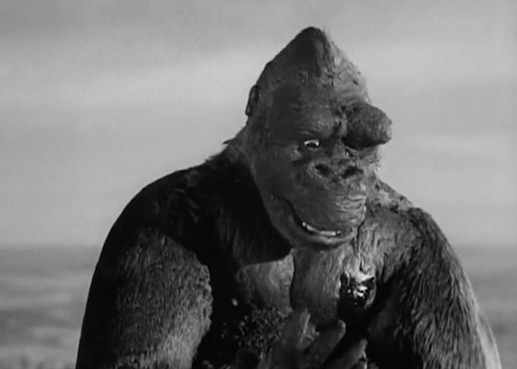
Kicking a very animated Stop-Motion Saturday off: a documentary about the incredible Willis O' Brien (1886-1962), the prehistoric world-creating genius behind The Lost World, King Kong and Mighty Joe Young - and the animation genius who inspired Bob Clampett to make cartoons.
Follow that by delving deeply into a Willis O' Brien playlist and then watching this piece on the great artist O'Brien mentored, Ray Harryhausen.
LOVED seeing The 7th Voyage of Sinbad and Jason & The Argonauts on the big screen!
The new Blu-ray set of Harryhausen classics is a keeper.
Like director and dyed-in-the-wool animation buff Joe Dante, we're big fans of George Pal.
The stop-motion fans at Way Too Damn Lazy To Write A Blog are especially fond of the George Pal Puppetoons.
Love the 1930's Puppetoons produced in Holland (often as advertising films promoting Philips high fidelity audio products), followed by the series made in America for Paramount Pictures in the 1940's.
The George Pal Puppetoons have been restored, thankfully.
The Puppetoon Blu-rays get our highest recommendation.
Of the restored Puppetoons, especially like volume #3.
There's very cool stop-motion animation on YouTube.
In particular, the Dutch Vintage Animation YouTube channel is quite a treasure trove, including a bunch of classic films by the brilliant Joop Geesink.
How can one follow such blazing stop-motion genius? By watching more blazing stop-motion genius by delving deeply into the incredible work of entymologist turned filmmaker Wladislaw Starewicz (1882-1965).
Hope to see such outstanding Wladislaw Starewicz films as The Magical Clock released on Blu-ray in the United States.
The Starewicz family and Doriane Films have made a few of these terrific films available in Europe.
Could the great-grandchildren of Wladislaw and grandchildren of Irina Vladislavovna Starewicz please, pretty please, travel to the U.S. and remind us dumb American classic movie buffs of the stop-motion animator's greatness and present a retrospective on Turner Classic Movies while you're at it?
Wladislaw a.k.a. Ladislaw Starewicz, Ladislas Starevitch, Ladislaw Starevitch and Ladislaw Starewitch created astonishing cinematic works, first in Russia, then for decades in Paris.
Wladislaw and Irina Vladislavovna Starewicz produced exceptional stop-motion films from 1912 through the end of the 1950's.
When someone innocently asks this blogger, Paul F. Etcheverry (A.K.A. Psychotronic Paul), "what's your favorite film?" one response that always gets the conversational ball rolling is, "that love triangle tale in which all the characters are dead insects - LOVE IT, LOVE IT, LOVE IT!"
We dig the 1922 Wladislaw and Irina Vladislavovna Starewicz gem FROGLAND the most!
The Starewicz masterpiece The Mascot packs more startling and surreal imagery into its 33 minute length than can be found in 140+ minute feature films.
How do we finish a stop-motion Saturday? With the ridiculously talented filmmaker, animator, director, special effects innovator and movie comedian Charley Bowers.
Known to the French (very enthusiastic fans of his films) as "Bricolo," Mr. Bowers began his cinematic career in the teens as producer for the Barré-Bowers Studio (Mutt & Jeff cartoons), a decade before he starred in the Bowers Novelty Comedies, a series that blended stop-motion animation with live-action slapstick.
Charley Bowers remains our favorite eccentric inventor in the history of motion pictures! Within that eccentric inventor persona, Bowers merges Buster Keaton's understated style with elements of the equally unconventional and imaginative silent movie comedian Harry Langdon.
After Bowers' starring 2-reeler series for FBO and Educational Pictures (a.k.a. "The Spice Of The Program") ended in 1928, he did make a successful transition into talkies and continued producing highly original (and way-out) stop-motion animation showcases.
The last stop-motion films by Charley Bowers and frequent collaborator Harold Muller were produced in the late 1930's and early 1940's.
One, Wild Oysters, appeared as part of the otherwise undistinguished Animated Antics series released by Paramount Pictures in 1940-1941. Am hard pressed to think of another cartoon that features crustaceans not only as main characters, but as bad guys!
It's likely that the usual suspects at Way Too Damn Lazy To Write A Blog are finished - at least for the moment - overworking all the superlatives available in the English language when discussing such filmmaking innovators as Willis O'Brien, Ray Harryhausen, George Pal, Joop Geesink, Wladislaw & Irina Vladislavovna Starewicz and Charley Bowers.
Born on this day in 1893: a documentary filmmaking innovator, producer of King Kong and Son Of Kong and co-inventor of Cinerama, the extraordinary Merian C. Cooper.
While well aware that Cooper, with director Ernest B. Schoedsack and special effects genius Willis O'Brien created a sensation with King Kong in 1933, the more I delved into Cooper's astounding career as world traveller/adventurer, fighter pilot, aviator and producer, both in silents and talkies, of feature films and documentaries for David O. Selznick/RKO Pictures, Metro-Goldwyn-Mayer and John Ford's Argosy Productions, as well as his forming of Pioneer Pictures to develop and champion the use of three-strip Technicolor in live action movies (starting with the RKO musical short subject La Cucaracha), the more mightily impressed I was.
While King Kong was Cooper's most famous production, he also made history at RKO Radio Pictures by teaming Fred Astaire with Ginger Rogers on FLYING DOWN TO RIO, arranging Katharine Hepburn’s screen test and beginning his 20+ year association with John Ford. Cooper's keen interest in Technicolor would eventually lead to its showcasing in the feature films Becky Sharp and Gone With The Wind.
There is so much to Cooper's work across varied fields of endeavor, it is tough to determine just where to begin! A good place to start is the following outstanding Photoplay Pictures documentary, I'm King Kong! The Exploits Of Merian C. Cooper, produced by Patrick Stanbury and directed by Kevin Brownlow and Christopher Bird for Turner Classic Movies, which explores the breadth and brilliance of Cooper's transitions from aviator to documentarian to Hollywood movie producer and co-inventor of Cinerama.
Wikipedia elaborates: Merian Caldwell Cooper (October 24, 1893 – April 21, 1973) was an American aviator, United States Air Force and Polish Air Force officer, adventurer, screenwriter, film director, and producer.
Cooper was the founder of the Kościuszko Squadron during the Polish–Soviet War and was a Soviet prisoner of war for a time. He was a notable movie producer, and got his start with film as part of the Explorers Club, traveling the world and documenting adventures.
He was a member of the board of directors of Pan American Airways, but his love of film always took priority.
Cooper was one of the first bomber pilots in World War I. After the war, he helped form the famous Kosciuszko Squadron in battle-torn Poland. He then turned his attention to producing documentary films that chronicled his hair-raising encounters with savage warriors, man-eating tigers, nomadic tribes, and elephant stampedes.
He returned to military service during World War II, serving with General Claire Chennault in China, flying missions into the heart of enemy territory and then changed the face of film forever with Cinerama, the original “virtual reality.” He is also credited as co-inventor of the Cinerama film projection process. Cooper's most famous film was the 1933 movie King Kong. He was awarded an honorary Oscar for lifetime achievement in 1952 and received a star on the Hollywood Walk of Fame in 1960.
The first "giant ape" movie, extending concepts animator Willis O'Brien showcased in the 1925 epic The Lost World, was unprecedented and a box-office sensation, very much influenced by Cooper's world travels and the two documentaries he produced with cinematographer Ernest B. Schoedsack. For more info, by all means read The Making of King Kong by George E. Turner and Dr. Orville Goldner).
The two King Kong films weren't just massive box office hits, they profoundly influenced one of Willis O' Brien's key successors as a master of stop-motion animation in the action/adventure/fantasy genre, Ray Harryhausen.
Mr. Harryhausen worked with Willis O'Brien on the stop-motion wizardry in Ernest B. Schoedsack's 1948 film Mighty Joe Young,
As a filmmaker, technology enthusiast and special effects designer, Cooper was on the advance guard and a key developer of the three-projector widescreen process, Cinerama. He directed the 1952 documentary This Is Cinerama.
New digital restorations of epic films produced using the process were presented at New York City MoMA in January 2018 as part of Cinerama Day. This included The Story of Cinerama: An Illustrated Lecture, presented by the Cinerama, Inc., digital restoration team of David Strohmaier and Randy Gitsch.
Mr. Strohmaier's 2002 documentary Cinerama Adventure accompanies the restored version of This Is Cinerama, completed by Cinerama, Inc. in 2017.
The Best Of Cinerama (1963), comprising segments from Cinerama movies shot in Rome, Paris, Vienna, Athens, Brazil, Japan, Africa, Israel and New Orleans. would be the last project Merian C. Cooper worked on. As David Strohmaier, Cinerama and 70mm champion, describes in the following piece, the restorations can be exceedingly painstaking albeit rewarding work, bringing modern digital technology together with the expertise of those who worked for Cinerama.